
What should you do after myofunctional therapy training?
What to do after myofunctional therapy training is one of the most common questions therapists ask after completing their training and realizing they still don’t feel confident seeing clients or building a business.
Prefer to Listen Instead?
This article is based on The Profitable Myofunctional Therapist™ podcast episode EP 57: How to Use Your Myofunctional Therapy Training.
You can listen to the podcast here.

Why So Many Trained Myofunctional Therapists Feel Stuck After Training
One of the hardest realities for many myofunctional therapists is finishing a training program and realizing they still don’t feel clinically confident.
You expected to walk away ready.
Ready to see clients.
Ready to explain treatment.
Ready to know exactly what to do next.
Instead, you’re left wondering:
Did I miss something?
Do I need another course?
Should I invest in more training… or just wait until I somehow feel more prepared?
This is where many therapists quietly get stuck.
They assume the solution is more education.
More certifications.
More studying before taking action.
But here’s the truth most people don’t say out loud:
Clinical confidence is not built inside a course.
It’s built through repetition.
No training — no matter how good — can replace the learning that happens when you begin working with real clients, answering real questions, and making real clinical decisions.
When you don’t use your skills, hesitation grows.
Not because you’re incapable, but because experience is what turns information into competence.
The therapists who gain momentum aren’t the ones who keep collecting credentials and letters after their name.
They’re the ones who start using what they already know — even before they feel completely ready.
If You Don’t Use It, You Lose It
Myofunctional therapy is not a training you put in your pocket for someday.
It’s a skillset that strengthens through implementation.
Many therapists assume they need to “get everything in order” or “feel more confident” before beginning. In reality, waiting creates more hesitation, not less.
Action restores clarity.
Seeing clients restores confidence.
Momentum restores belief.
The fastest way to feel capable again is simple: start using what you already know.
What to Do After Myofunctional Therapy Training: The 3 Decisions That Move You Forward
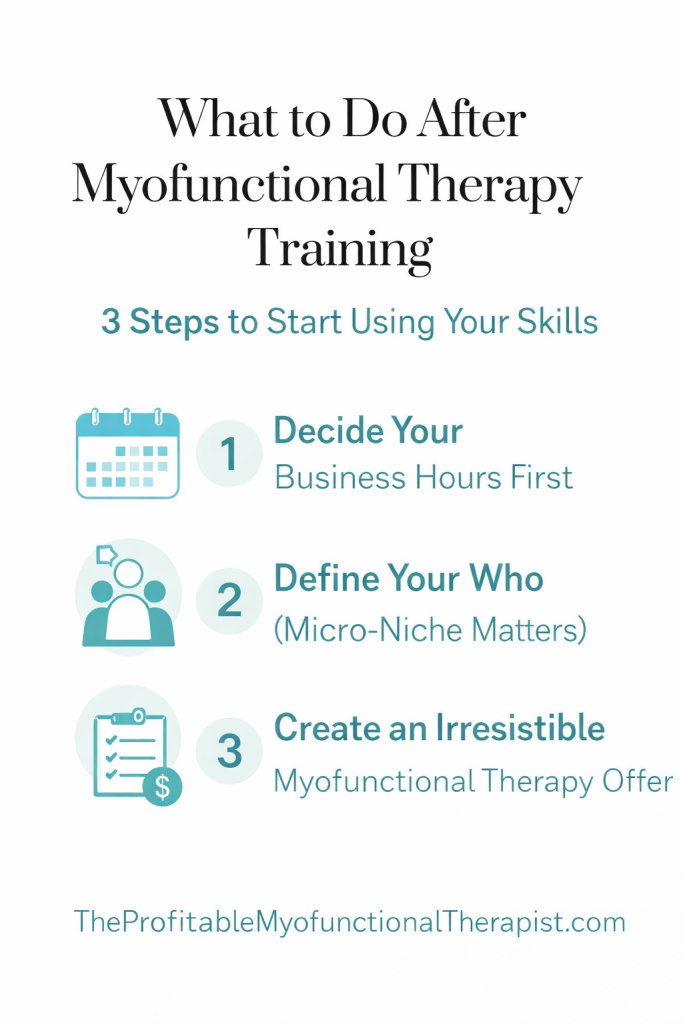
Step 1: Decide Your Business Hours First
Most therapists try to figure out clients before they decide when they are actually available.
This creates inconsistency and overwhelm.
Instead, start with structure.
Block dedicated business hours on your calendar — even if they are small at first. ( I recommend at least 3 hours per week to have available. You can’t build a “6 figure – life that I’m bonkers about business” in 30 minutes here and there.)
These hours become protected implementation time. We call that tiger time over here at PMTHQ.
What Your Business Hours Should Include
These hours can be used for:
- Seeing clients
- Marketing your services
- Building systems
- Practicing your workflow
Many successful therapists begin with only a few weekly hours. As demand grows, they either expand availability or raise prices.
Structure creates momentum long before a schedule fills.
Step 2: Define Your Who (Why Micro-Niching Matters)
One of the biggest mistakes new myofunctional therapists make is trying to help everyone. In 2026 – you can’t be looking for anyone with a purse and a pulse.
Adults.
Children.
Sleep-disordered breathing.
Chronic pain.
While this feels safer, it actually makes marketing harder.
When your message speaks to everyone, it resonates with no one.
Casting a bigger net will not get you more fish. In fact, it just might get you no fish.
How Choosing a Niche Builds Authority Faster
Defining your ideal client clarifies:
- Your messaging
- Referral relationships
- Treatment positioning
- Pricing confidence
A clear niche allows potential clients — and referring providers — to immediately recognize when you are the right fit.
Specificity builds authority faster than generalization ever will.
Just so we’re clear here…your niche doesn’t have to be gender or age specific, such as adult vs child. Or man vs. woman. You can choose to niche in on a “topic” and get very deep an knowledgable on that sliver of real estate. In this case, you don’t want to be jack of all trades. You want your knowledge to be an inch wide and a mile deep.
Step 3: Create an Irresistible Myofunctional Therapy Offer
After identifying your ideal “easy, peasy, dreamy client”, the next step is packaging your services clearly.
Many therapists unintentionally undersell themselves by offering individual session prices instead of presenting a complete transformation. This makes them a commodity and people can simply shop prices for the cheapest person. You don’t want to be competing for the bottom of the barrel clients. You want to be the creme de la creme on top!
(I love the example of buying a pair of jeans that makes your butt look amazing. Do you find those jeans for $20 on the end cap at Walmart? Most certainly not. But you probably find them at Bloomingdales or Neiman. You get the picture here. Don’t be corn or wheat my friend!)
What Makes an Offer Irresistible
An effective offer explains:
- The problem you solve
- The journey you guide clients through
- The support and accountability included
- The expected outcomes
Clients are not buying tongue exercises.
They are investing in change. They are buying the transformation that you are going to take them through.
When your offer bridges the gap between where a client is now and where they want to be, selling becomes a natural extension of helping. Selling is just offering them a solution to the problem they’ve already identified.
Become unapologetic about your solution.
Full stop.

Why Confidence Comes After Action — Not Before
One of the most common fears after training is feeling unprepared or unconfident.
But readiness and confidence is not a prerequisite for starting.
It’s a result of starting. It’s a by-product of “just get your butt moving”.
Every therapist feels clunky at first, especially if you’ve been doing hygiene for years. You’re already good at that. So starting over with something new is s-c-a-r-y.
But soon, communication improves.
Explanations become clearer.
(You don’t feel like a greasy Subaru salesman anymore.)
Confidence grows through doing the work — not waiting to feel perfect.
The Real Reason Training Alone Doesn’t Build a Business
Clinical education teaches how to deliver therapy.
It rarely teaches how to build a practice or how to get clients, manage your money, save for taxes or create a marketing plan.
Marketing, messaging, pricing, and client acquisition are necessary business skills — and they become the majority of your work once you begin practicing.
Starting imperfectly is far more powerful than remaining perfectly prepared.
Around here – we call that “taking ugly, imperfect action” and it is one of the cornerstone principles inside The Profitable Myofunctional Therapist™ program.
[Perfectionism is a real struggle too. Learn how to overcome perfectionism when starting your myofunctional therapy business.]
Ready to Explore Your Next Step?
🎙️ Listen to EP 57: How to Use Your Myofunctional Therapy Training
If you want help mapping your next step, you can book a Get Unstuck Call here.
💙 Xo,
Carmen

0 Comments