

If your myofunctional therapy website has been sitting on your to-do list for months, I want to say something that might sting a little. It isn’t stuck because you can’t design. It’s stuck because there are four decisions you haven’t made yet, and every week they stay unmade the website quietly becomes the reason nothing else in your business moves. I see this constantly with the therapists I work with, and I’ve been there myself, so today I’m walking you through the decisions in the order I’d make them.
I recorded this one for the myofunctional therapist who finished her training, knows she needs a site, and keeps telling herself she’ll get to it next week. You’ll get the four decisions, what a first version needs, and what to do once it’s live, because a site nobody can find is a brochure sitting in a drawer.
Prefer to Listen Instead?
This article is based on The Profitable Myofunctional Therapist™ podcast, Episode 98: Your Website Is Not a Design Problem. It Is a Decision Problem. You can listen to the podcast here.
Prefer to Watch Instead?
Do You Need a Myofunctional Therapy Website in 2026?
Yes, and the reason is simple. There’s no phone book to flip through anymore, so if somebody can’t find you online, they can’t find you.
Do you need one before you can get paid? No. You can raise your hand to someone who needs your help and get paid without a finished site. I didn’t get paid before mine was live, but only because I got it up and running quickly. What I don’t want is for your website to be the thing you’re still circling a year from now.
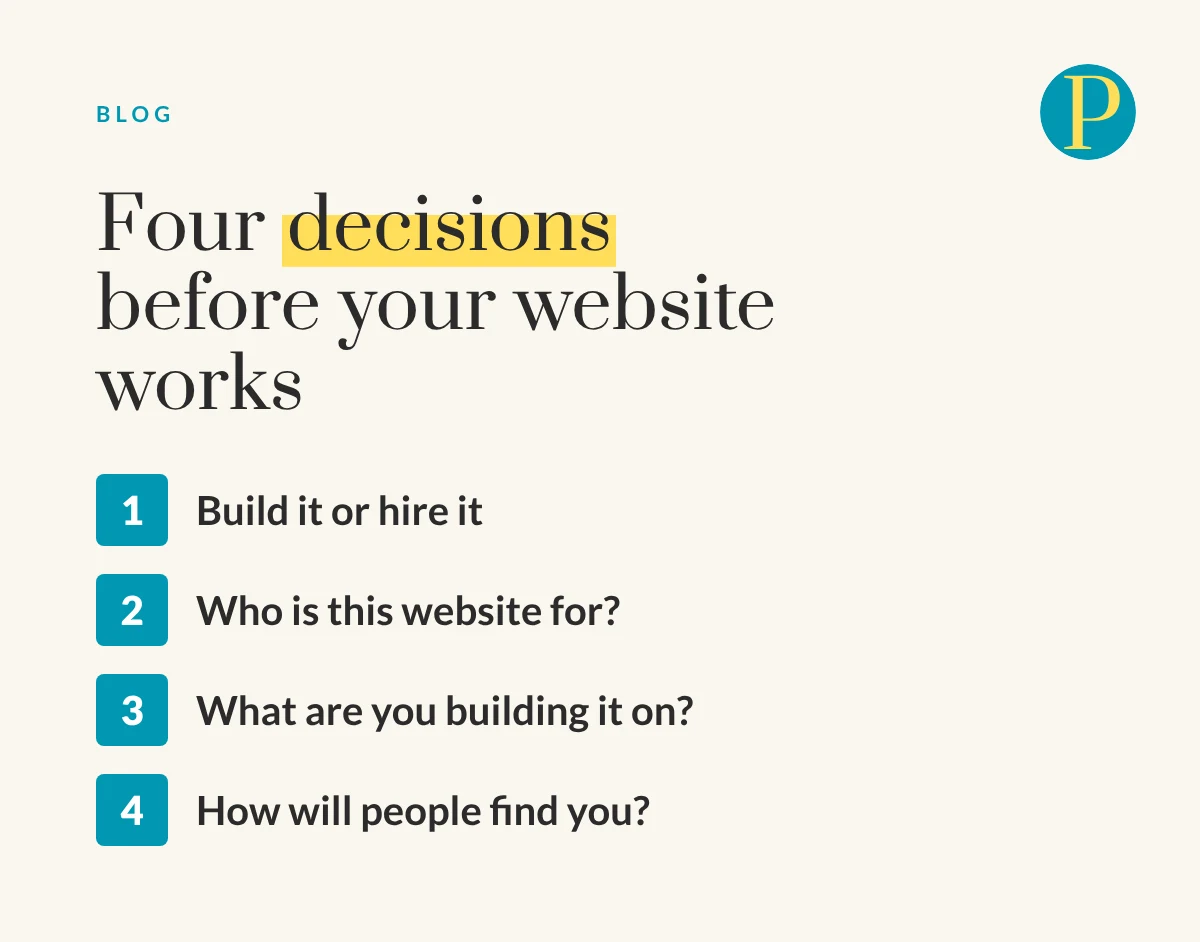
Decision 1: Build It or Hire It
You are going to spend time or money on this. There is no third option, and pretending there is one is what wastes the most time of all. Nothing is free.
If you have the time, build it yourself, and I wholeheartedly think you can. If you don’t have the time, plan to put real money behind it and have a professional do it. Either way works. The only version that doesn’t work is hoping it costs you nothing.
Own It, No Matter Who Builds It
Here’s the part that matters most. Many of the therapists I work with are rebuilding right now because they paid someone to build a site they can’t control. They can’t log in, they can’t look at their analytics, they can’t optimize anything, and every change turns into a fight with the person who built it. The site also tends to come out generic, which hurts how it shows up in search.
Whoever builds it, you need to own it. You need to know how to update it, save it, back it up, and clean it up if something goes wrong. I believe in teaching a woman to fish rather than handing her a fish, and a website owner who can’t do those things is renting her own business.
If that’s you, you might be starting over, and that’s okay. You can do hard things.
Stop Indulging in Overwhelm and Decide
Around my headquarters we call this decide and do. Nobody on my team, me included, gets to sit in overwhelm, and I say that as a human who feels it too. Feel it, name it, and ask what the first step is. When I’m overwhelmed it’s almost always because I don’t have a clear plan, and stopping doesn’t produce the result you want.
So here’s the decision. Am I building my website, or am I hiring it done? End of story. Next.
Decision 2: Who Is This Website For?
This is also the reason several of my students are starting over. They built their sites to be everything to everybody, and in 2026 that makes your message absolute oatmeal that lands with no one.
You need to know your who, and you need an I help statement: I help (who) with (what) by doing (how). In the first three seconds, a visitor should think, this person is talking to me, I feel heard, I feel seen. That doesn’t mean you’re peddling services in those three seconds. It means you’re writing to one person and using the words she uses.
My own ideal customer file, from the exercises in The Profitable Myofunctional Therapist™, runs six pages. It includes a word bank of what my who is searching for, and I can tell you she is not typing “myofunctional therapist near me.” Whether your who is a mom, a woman on her own, a parent of a child, an adult with a diagnosed sleep apnea, or a chronic pain client changes everything about the words you choose. I can’t answer that for you, because I don’t know who your who is. For the full story on why this matters, listen to Why Myofunctional Therapists Aren’t Getting Clients: The Niche Mistake That Keeps You Stuck.
Decision 3: What Are You Building It On?
If you’re building it yourself, tools make this easier, and nothing about it has to be fancy. I use Bluehost for hosting, WordPress for the site, Divi as the plug and play page builder, and Rank Math for SEO. Some people use Yoast, and I prefer Rank Math.
Heads up: that’s my referral link. You’ll get a discount on hosting, and I may earn a small commission.
I stay on WordPress because outside of my domain and my hosting I don’t pay for anything else. I bought my Divi theme one time and use it on all of my sites. Know what every line on your own site bill is for.
My first site took 200 hours, and I didn’t know anything. My MBA taught me nothing about being an entrepreneur and nothing about building a website, so I had no technical head start. What I did have is that I didn’t sit there being a big baby about it. I decided to figure it out, and I did. Now my AI team writes custom CSS for me and I paste it in myself.
Here’s me telling on myself. Right before I recorded this episode I looked at my own Core Web Vitals, and one of my pages was loading far too slowly. If I’m still tuning mine, you will be tuning yours.
Decision 4: How Will People Find You?
Once your site is built, the goal is to stop being invisible to the people who are your human. I teach this in the Visibility & Authority lesson of The Profitable Myofunctional Therapist™. You are not after everybody with a purse and a pulse. You are after your who.
Start by investigating how your practice appears online. Not how you think it appears, not how you hope it appears, but whether people can find you.
Can They Find You, Understand You, and Trust You?
Those are the three questions. You want to be findable, you want to be understandable, and you want to be trustworthy.
This is where your AI team earns its keep. In my training, we use AI to run the investigation, and when you set it up right it gives you truth over comfort every time. It is not your cheerleader. I want it to tell me when my website looks like an amateur build, and I would rather hear that from software than from a prospect who clicks away without a word.
Check the technical basics too. A noindex tag tells Google there is nothing to see, and I’ve seen it on sites that someone else built for a therapist. Check how fast your pages load, because Google cares about that. And look at the feeling the site gives, since a font that’s hard to read or a design that feels like a different kind of business changes whether a visitor trusts you.
Want a Full Audit of Your Website?
If you already have a website and you’re curious how it stacks up, I also offer agency services, including full website audits. You get a report with scores and a prioritized list of what to fix first, from high-priority items like that noindex tag to SEO, GEO, headers, and image alt text. Reach out to me wherever you found this episode and tell me you want an audit done on your website.
Your Website Is Never Done
Once it’s live, you’ll keep improving it. Speed, Core Web Vitals, and technology all change, and things get better, so you’ll always be tuning something. You just won’t be spending hours on it.
Most of your time shifts to marketing. With my students, once the website is done we move the focus off the site and into marketing, and maybe 10% of the week stays on the website. The rest is marketing tasks, including search content, and getting in front of the people who need you. Where those people are depends on your who, and I can’t tell you that.
Blog posts are a big piece of this. Long-form content that’s written well and is long enough can keep working for you long after you publish it. When someone asks me for the dirty secret, I tell them you have to do the boring business basics over and over again, and marketing is the biggest piece of that.
What Your First Version Needs
A website is complete enough to launch with three things. A home page and an about page. A way for people to contact you, with your scheduler embedded so the buck stops there. And analytics, so you can study what’s happening.
That is a launched website. Everything else comes after.
Frequently Asked Questions
Do I need a myofunctional therapy website before I get my first client?
No. You can get paid before your site is finished. What you can’t do is leave it unfinished for a year, because a website is how people who don’t already know you find you. Build it alongside your first clients, not instead of them.
Should I build my myofunctional therapy website myself or hire someone?
Either works, and either one costs you. Building it costs time, hiring costs money, and nothing is free. Whichever you choose, make sure you own the site, can log in, and can update it, back it up, and see your analytics without asking permission.
How do I make my website speak to the right person?
Start with your who and an I help statement: I help (who) with (what) by doing (how). In the first three seconds a visitor should think this person is talking to me. Write to one person, using the words she uses to describe her problem.
What tools do I need to build a website for my myofunctional therapy practice?
You need hosting and a domain, a content management system, a page builder, and an SEO plugin. I use Bluehost, WordPress, Divi, and Rank Math. Other combinations work, and it doesn’t have to be fancy. It has to be built.
How do I know if people can find my website?
Ask three questions: can they find me, can they understand me, can they trust me. Then check the technical basics, like a noindex tag telling Google to skip your pages and how fast your pages load. An AI assistant set up to give you truth over comfort can run that check with you.
Is a website ever finished?
No. You launch it, then keep improving speed, content, and clarity as technology changes. Once it’s live, most of your weekly time moves to marketing, with a small slice staying on the site.
Keep Listening: Related Episodes
- EP12: Your 24/7 Personal Assistant: How to Make Your Website Work for You, what to do once your site is built so it works while you’re not.
- EP74: Why Myofunctional Therapists Aren’t Getting Clients: The Niche Mistake That Keeps You Stuck, the who behind Decision 2, and what happens when you try to talk to everybody.
- EP93: My Top Five AI Employees and What They Do, the AI team I use to run my week, the same kind of help that writes my site code.
Make the Decisions, Then Build the Thing
If your myofunctional therapy website is still a blank page and a long list of maybes, pick the first decision and make it, build it or hire it. Then write your I help statement, choose what you’re building it on, and plan how people will find you.
If you want help sorting out which decision is holding you up, book your Get Unstuck Call and we’ll talk about where you are, what’s stuck, and what makes sense for you next.
Friend, I can hand you the order and the tools, but I can’t make the decision for you, and a year from now you’ll either have a site doing its job or the same tab still open on your laptop.
Xo,
💙 Carmen
About Carmen Ball
Carmen Ball (formerly Carmen Woodland) is a renowned, global myofunctional therapist, business coach, and host of The Profitable Myofunctional Therapist™ podcast. Over the past decade, she has helped thousands of people in her private myofunctional therapy practice (Impact Myofunctional Therapy – formerly Integrative Myofunctional Therapy) and coached hundreds of trained therapists to build profitable online businesses of their own. She is the creator of The Profitable Myofunctional Therapist™ program and Learn Myofunctional Therapy in 60 Days or Less (LMT60), a clinical training program for dental and health professionals. Carmen’s approach is simple: you already have the skills and the license. Now let’s build the business around them. She works with therapists around the world who are ready to stop spinning their wheels and start building a business they are genuinely bonkers about.

0 Comments