

If you’re wondering why myofunctional therapy clients stop coming, it’s usually one of four reasons: you’re not speaking to a specific ideal client, your offer isn’t built for her, your systems and client pathway aren’t working, or you’re not visible enough to be found. Referrals dry up fastest when a partner doesn’t know exactly who to send you.
You got a referral. A real one, a dentist who likes you, a patient who fits, tongue tie, mouth breathing, the whole picture. Then the same dentist stopped sending anyone else, and you started wondering if something was wrong with you.
Nothing is wrong with you. Something is wrong with the match.
I learned this one the hard way. Early on, a dentist would get stumped by a patient, run out of ideas, and think, maybe myofunctional therapy will help. Sometimes that landed me a great client. Most of the time I sat there thinking, “what the hell are you talking about? why did you think I was the one to fix this?” He wasn’t referring me a client. He was referring me his confusion.
Why Myofunctional Therapy Clients Stop Coming: The Referral Isn’t the Problem, the Fit Is
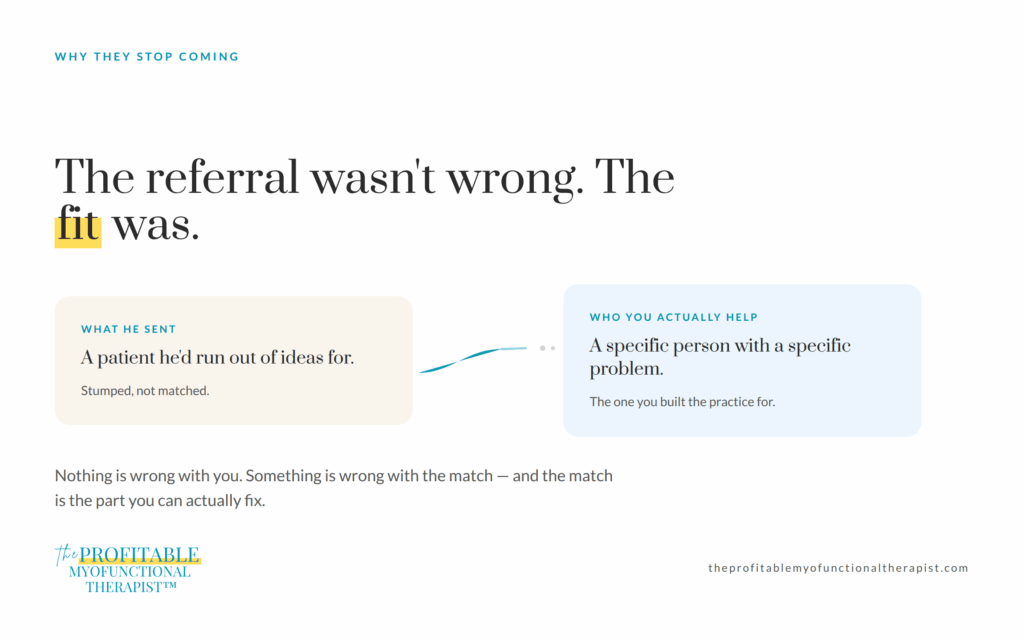
When the client is right, this work isn’t hard. She has the specific problem you solve, she’s ready, and the sessions build on each other the way they’re supposed to. When the client is wrong, you can be a skilled therapist and still watch her disappear by session two, because you were never the right person for what she actually needed.
That’s not a rare glitch. Referral misdirection is common enough across healthcare that a majority of clinically inappropriate referrals go to the wrong provider or weren’t needed at all. Dentists aren’t specialists in what you do. When they’re stumped, “maybe try myo” is a guess wearing a referral’s clothes.
Multiply that by every square-peg client you’ve been handed since you finished your training, and you’ve got the real math behind “I don’t have clients.” It was never about your skill. It was about who was being sent to your door in the first place.
A vague referral isn’t a failed referral. It’s an incomplete one, and you’re the only person who can finish it.
Why “Just Get More Referrals” Doesn’t Fix It
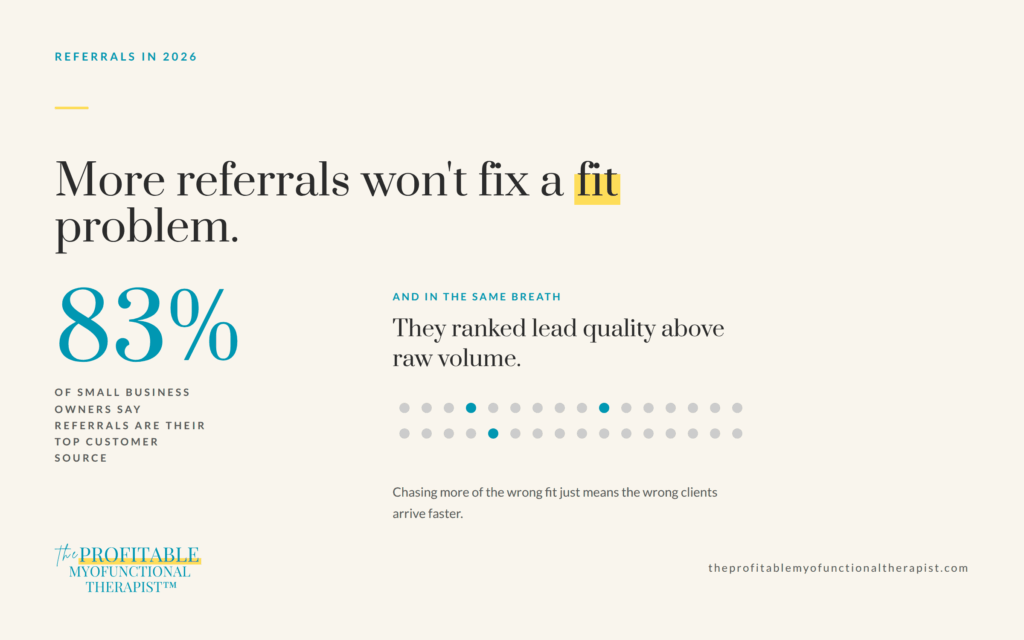
Chasing more referrals when the referrals you already get are the wrong fit just means more wrong-fit clients arriving faster. Small business owners feel this too. In 2026, referrals became the top customer source for 83% of small business owners, and those same owners ranked lead quality above raw volume when asked what actually moved their numbers. Quality beats volume, and quality starts with the referral partner knowing exactly who to send.
Your dentist can’t read your mind. If your marketing to him has ever been “send me your myo patients,” you handed him nothing to work with. He doesn’t know what a good referral looks like from your side, so he guesses, and his guesses default to whoever stumped him that week.
The Fix Isn’t a Referral System. It’s Telling Your Partners Exactly Who You Are.
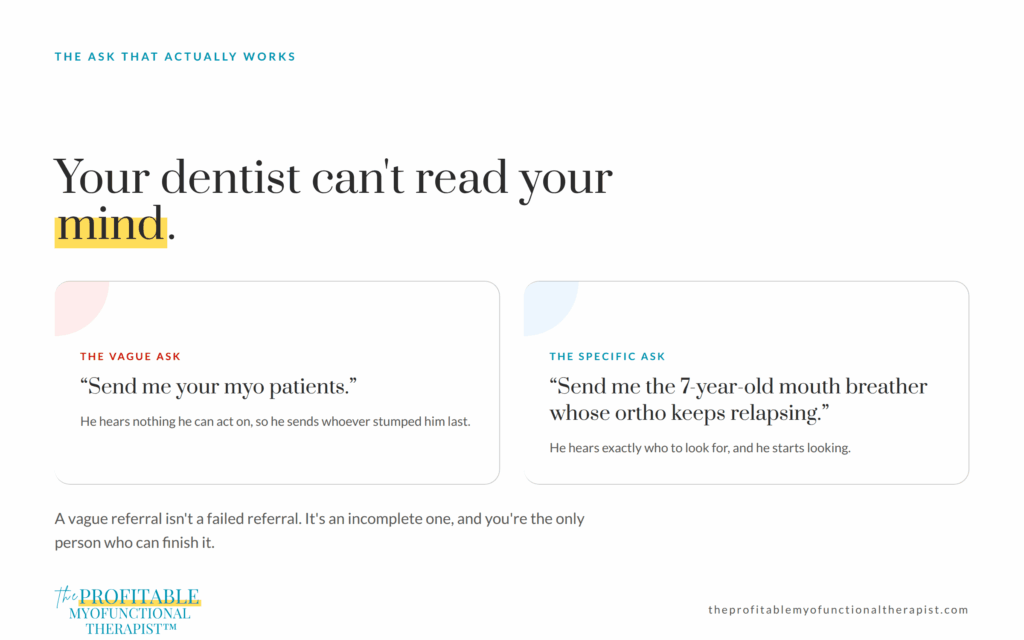
Here’s what changes the pattern. Sit down with your referral partner and get specific. Not “send me anyone with a tongue tie.” Specific presentation, specific age range, specific symptoms, specific language he can use in the chair to spot her before she even leaves his office. Give him a name for her if it helps him remember. Make it so easy to recognize her that he can’t confuse her with someone else.
One of my students built her whole practice around a single primary referring provider who sent her the right clients consistently, not because she got lucky, but because that provider knew precisely who to look for. That is one student’s result, not a guarantee. Results depend on your own market, effort, offer, consistency, and follow-through, but it shows what the fix looks like in practice.
How to Tell Which Lever You’re Missing
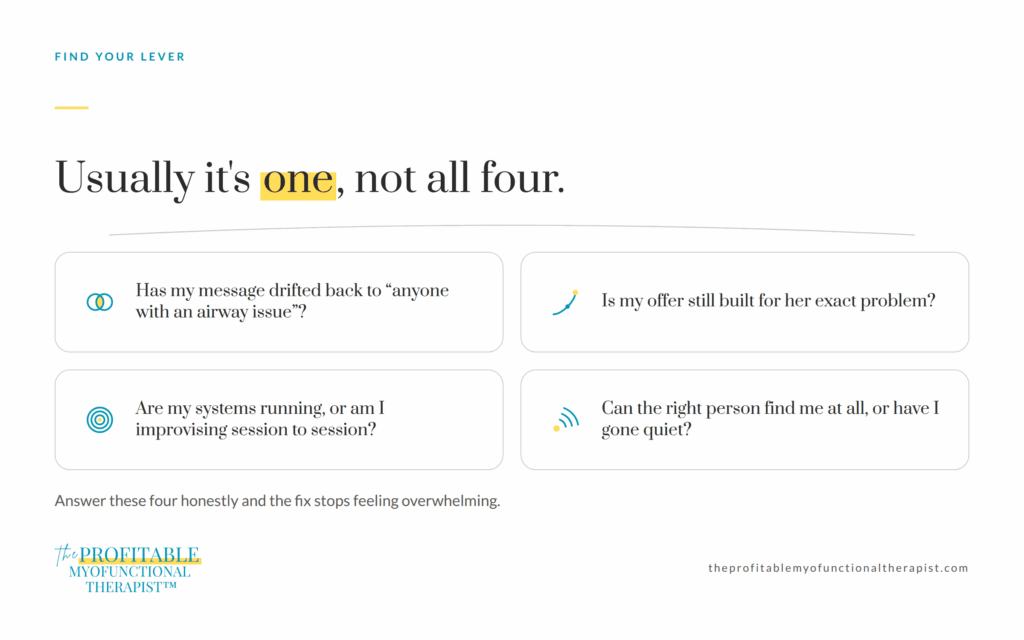
Referral fit is one piece of a bigger picture. If clients were coming and now they’ve slowed or stopped, ask yourself which of these is actually true right now.
Are you still speaking to one specific person, or has your message drifted back to “anyone with an airway issue”? Is your offer still built for her exact problem, or has it gotten generic to appeal to more people? Are your systems and client pathway actually running, or are you improvising session to session? And can the right person find you at all, or have you gone quiet?
Usually it’s not all four. It’s one, sometimes two, and once you know which one, the fix gets a lot less overwhelming.
Getting Started: The Four Levers That Keep Clients Coming
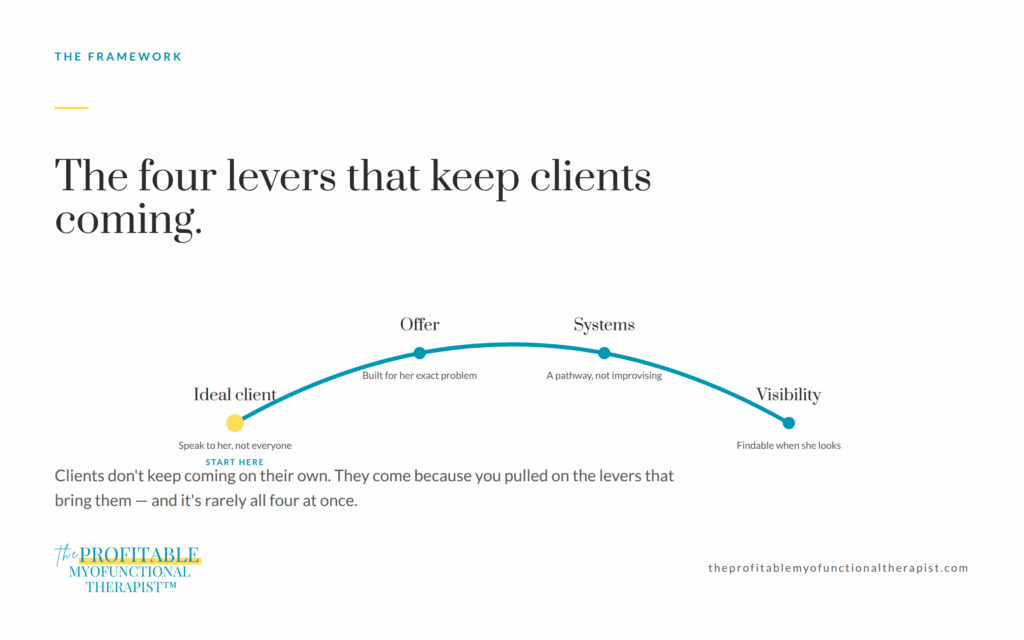
This is just business. Clients don’t keep coming on their own, without you pulling on the levers that bring them. Here are the four that matter.
Speak directly to your ideal client. Not “people with mouth breathing issues.” The specific person, her specific situation, in language she’d use to describe her own problem at 11 p.m. when she’s Googling it.
Build an offer designed for that one person. A generic package for everyone is a strong package for no one. When your offer matches her exact problem, saying yes stops feeling like a decision.
Get your systems and client pathway working. This includes the referral partner piece above. It also includes what happens between sessions, how you follow up, and whether a client ever wonders what’s next.
Be visible enough to be found. Referrals help, but they’re not the whole engine. If your ideal client can’t find you on her own, you’re relying entirely on someone else remembering you exist.
Friend, if you’re not pulling on one of these, clients eventually stop coming, and it’s not because myofunctional therapy stopped working. It’s because you haven’t built the CEO skills yet that keep a business growing instead of just surviving on whoever happens to wander in.
Ready to Find Out Which Lever You’re Actually Missing?
Most trained therapists can name the symptom, fewer clients than they expected, but not the actual lever behind it. If you’ve been asking why myofunctional therapy clients stop coming and still can’t name yours, a Get Unstuck Call is 45 minutes where we find it together and figure out what to build first.
Book your Get Unstuck Call here.
Xo,
💙 Carmen
Frequently Asked Questions
Why do myofunctional therapy clients stop showing up after one or two sessions?
Usually because the referral wasn’t the right fit to begin with. When a client isn’t the specific person your work is built for, sessions stop feeling necessary to her, and she quietly stops booking. It’s rarely a sign you did anything wrong clinically.
Is it my fault if a referral partner sends me the wrong client?
Not entirely. Referral partners can’t read your mind, and most weren’t given a clear picture of who to send. The fix is giving them that picture, not blaming yourself for a guess they made without enough information.
How do I get dentists to refer better-fit myofunctional therapy clients?
Get specific with them. Describe the exact patient presentation, symptoms, and language that signals a good fit, and make it easy for them to recognize her in the chair. Vague asks get vague referrals.
Do I need a bigger marketing budget to fix a client-retention problem?
Not necessarily. Budget matters less than clarity. If your offer and message aren’t built for one specific person, more spend just brings in more of the wrong fit, faster.
What’s the difference between a visibility problem and a referral problem?
A visibility problem means your ideal client can’t find you at all. A referral problem means people are finding you, but the wrong people, because your referral sources don’t know exactly who you’re looking for.
How many of the four levers do I need to fix at once?
Usually just one or two. Most trained therapists aren’t broken across all four, they’ve let one slip, often the referral clarity piece, and the rest follow once that one is addressed.
About Carmen Ball
Carmen Ball (formerly Carmen Woodland) is a renowned, global myofunctional therapist, business coach, and host of The Profitable Myofunctional Therapist™ podcast. Over the past decade, she has helped thousands of people in her private myofunctional therapy practice (Impact Myofunctional Therapy – formerly Integrative Myofunctional Therapy) and coached hundreds of trained therapists to build profitable online businesses of their own. She is the creator of The Profitable Myofunctional Therapist™ program and Learn Myofunctional Therapy in 60 Days or Less (LMT60), a clinical training program for dental and health professionals. Carmen’s approach is simple: you already have the skills and the license. Now let’s build the business around them. She works with therapists around the world who are ready to stop spinning their wheels and start building a business they are genuinely bonkers about.


0 Comments