
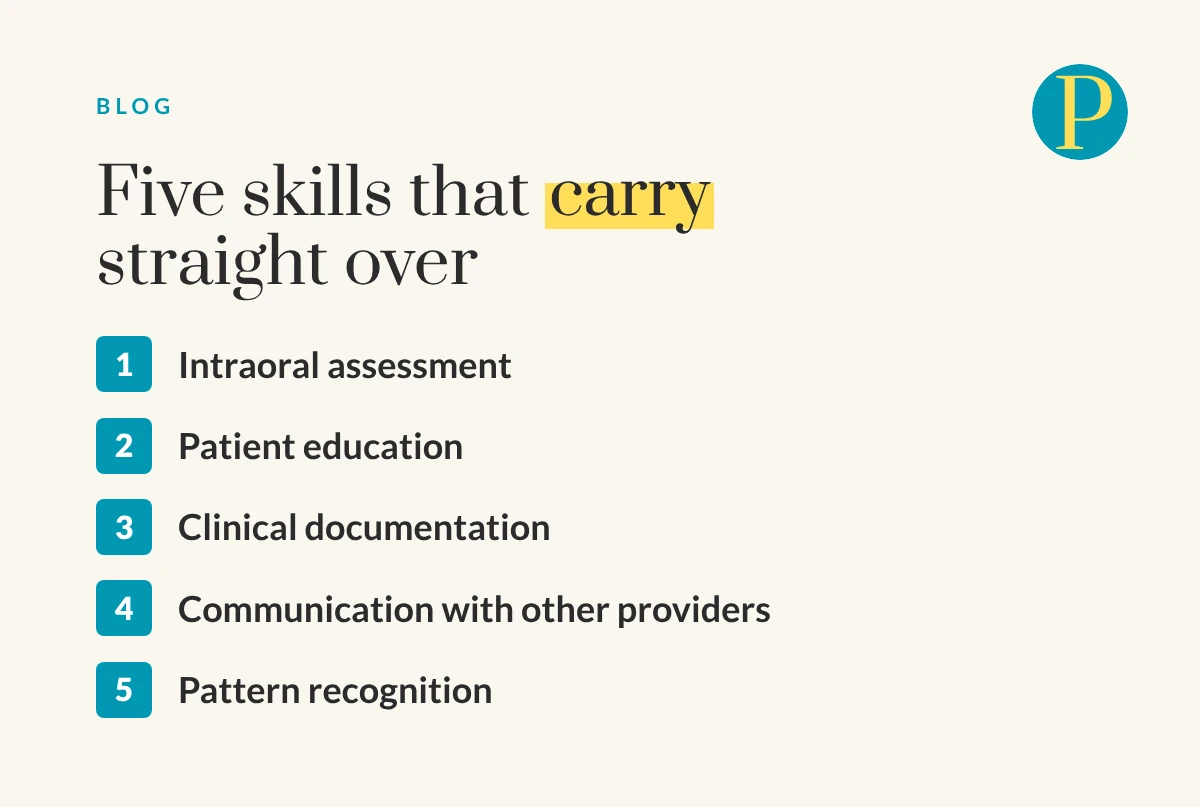
Myofunctional therapy for hygienists comes with five skills that carry straight over: intraoral assessment, patient education, clinical documentation, communication with other providers, and pattern recognition in the mouth. Three skills don’t transfer: functional movement assessment, therapy sequencing, and running your own practice. You’re starting from the middle, not from zero.
A hygienist asking whether her skills carry over is often asking something bigger, which is whether walking away from a degree she spent years and a pile of student loans on means she picked wrong. I was her.
I stayed in hygiene long after I knew it wasn’t for me. I’d put so much into earning the skill, I was afraid it was all I could do, and I worried what people would think if I changed careers.
So I’m going to run this audit straight, parts that don’t transfer included, because a list that says everything you know is perfect would be useless to you.
What transfers, and it’s more than you think
Intraoral assessment. You’ve looked in thousands of mouths. You’re not squeamish, you’re fast, and you know how to position a patient and get a clear view without a fight. Someone coming from a non-clinical background has to build what you already own.
Patient education. You’ve given the flossing talk to people who didn’t want to hear it, and you’ve learned to read the moment someone stops listening. Myofunctional therapy leans heavily on education and behavior change, so this is the most transferable thing you’ve got.
Clinical documentation. You chart, and you know what a note has to say to hold up. Assessment reports in this work run longer and travel to other providers, but the habit is one you already have.
Communication with other providers. You’ve talked to dentists, specialists, and front desks, and you know how a referral moves through an office. Referral relationships matter in this work, and you already know how that conversation goes.
Pattern recognition. This is the one people miss. You’ve already seen the mouth breathers, the tongue thrusts, the scalloped tongues, and the kids with narrow palates. A mini review in Frontiers in Public Health reports mouth breathing prevalence in children ranging from 11 to 56 percent across the studies it summarizes, so these presentations are likely sitting in your schedule right now. You just had nothing to offer them.
You’ve been looking at this for years, and training gives you the name for what you’ve been seeing.
What doesn’t transfer, and pretending otherwise would set you up to fail
Functional assessment. Hygiene trains you to evaluate tissue. This work evaluates movement, posture, and coordination, and watching how a tongue behaves during a swallow is a new skill that takes practice before you can see it reliably.
Therapy sequencing. Knowing a disorder exists isn’t the same as knowing which exercise to teach, in what order, for how long, or when someone is finished. That’s the clinical craft of the field, and it’s what you’re buying when you train.
Running your own practice. Nothing in hygiene school taught you pricing, marketing, client pathways, or where the heck clients even come from. A 2025 study in the Journal of Dental Hygiene named business management as one of five core themes among hygienists practicing myofunctional therapy, so if nobody ever taught you this part, you’re in good company. It’s a separate build from the clinical training, and it comes after the training.
The part nobody frames correctly
The conversation about leaving the operatory usually gets framed as a passion decision, and for plenty of hygienists it’s also a body decision.
A 2022 survey of 468 Italian dental hygienists found that 91 percent reported suffering or having suffered a musculoskeletal disorder, with the neck, shoulder, and lower back the most affected areas. The work you do now happens in a fixed posture with repetitive loading, for hours at a stretch.
Myofunctional therapy is a different physical job, built around talking, demonstrating, and watching rather than working over a patient with an instrument in your hand. I’m not claiming it heals anything that has already happened to your body, and the business side takes real work. If you’re weighing other ways out of the operatory, the difference in posture belongs in that comparison.
Where your hygiene background gives you an advantage
Your hygiene background helps in two ways I see right away.
Credibility with referring providers. When you call a dental office about a shared patient, you’re a clinician talking to clinicians. You know what their day looks like and you don’t waste their time, and that’s a head start on the referral conversation.
A vocabulary you already own. You speak dentistry. A module on airway and orthodontics starts from words you already use, so you’re learning how to apply them to function instead of learning a new language from scratch.
Where to start with myofunctional therapy for hygienists
Learn Myofunctional Therapy in 60 Days (LMT60) is self-paced online clinical training with six modules and more than 30 lessons, covering an introduction to orofacial myofunctional therapy, airway and orthodontics, tongue ties, sleep and breathing, and the therapy itself.
Friend, the degree wasn’t a waste. You’ve been writing it off as a sunk cost, and it’s the reason you’re starting from the middle.
Xo,
💙 Carmen
Frequently Asked Questions
Can dental hygienists do myofunctional therapy?
Yes, hygienists practice myofunctional therapy, and a 2025 study in the Journal of Dental Hygiene examined how they do it and what barriers they face. What you’re permitted to do depends on your state and your license, so your own licensing board is the right authority on scope of practice.
What hygiene skills transfer to myofunctional therapy?
Intraoral assessment, patient education, clinical documentation, communication with other providers, and pattern recognition in the mouth all carry straight across. Functional movement assessment, therapy sequencing, and running a practice are the new parts.
Do I need to stop working as a hygienist to do myofunctional therapy?
No. LMT60 is self-paced online training, so you can fit it around your own schedule, and whether you ever leave hygiene is a separate decision. The wider set of career options is covered here.
Is myofunctional therapy easier on your body than dental hygiene?
It’s a different physical job, built around talking, demonstrating, and watching rather than working over a patient with an instrument. A 2022 survey of Italian hygienists found that 91 percent reported a musculoskeletal disorder at some point, and no training reverses an existing injury, so that question belongs with your own healthcare provider.
Does being a dental hygienist help with myofunctional therapy training?
It can, because you already speak the language of dentistry and you’ve spent years looking inside mouths. The functional assessment side is new for everyone. Hygienists who’ve been through it are in the community.
About Carmen Ball
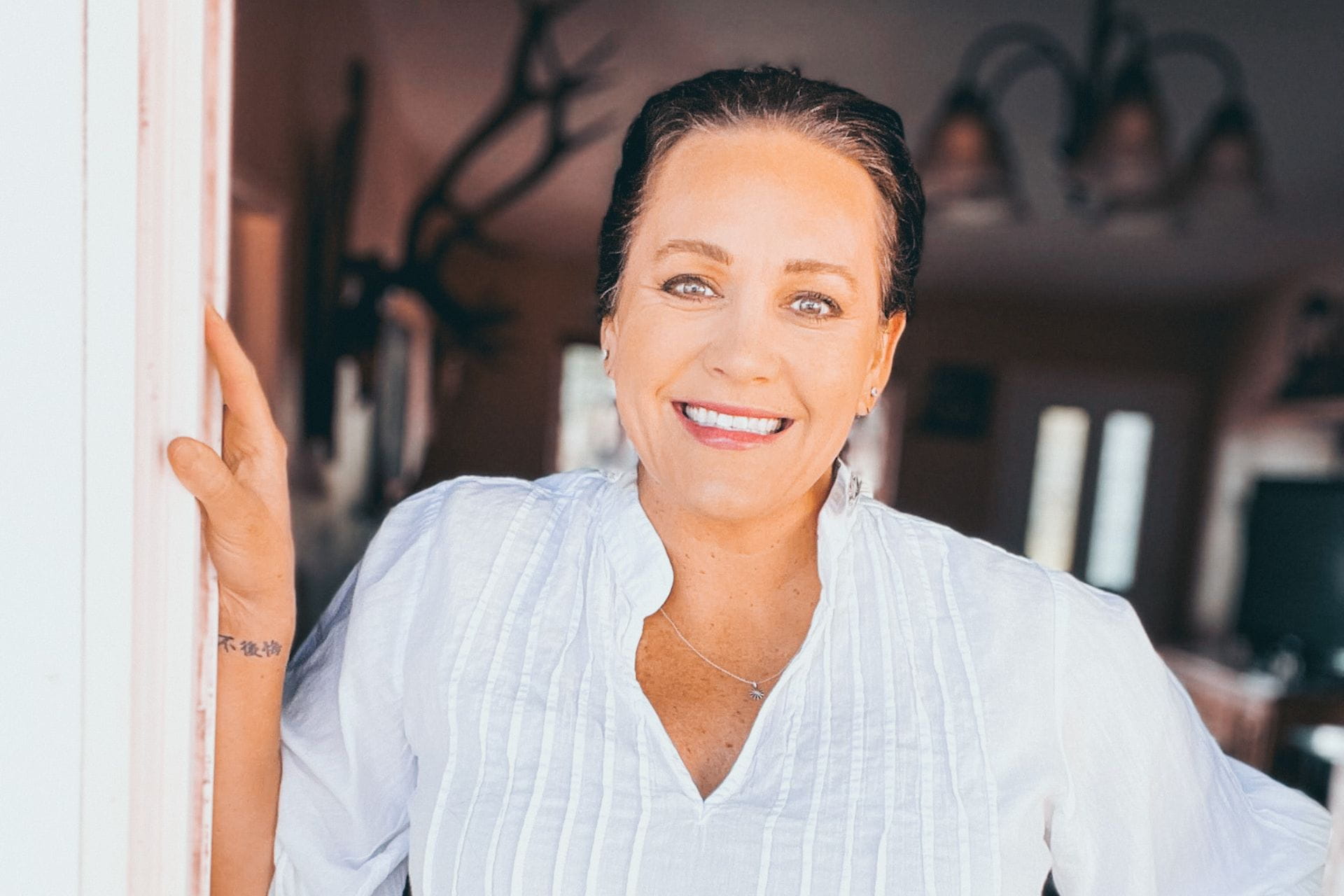
Carmen Ball (formerly Carmen Woodland) is a renowned, global myofunctional therapist, business coach, and host of The Profitable Myofunctional Therapist™ podcast. Over the past decade, she has helped thousands of people in her private myofunctional therapy practice (Impact Myofunctional Therapy – formerly Integrative Myofunctional Therapy) and coached hundreds of trained therapists to build profitable online businesses of their own. She is the creator of The Profitable Myofunctional Therapist™ program and Learn Myofunctional Therapy in 60 Days or Less (LMT60), a clinical training program for dental and health professionals. Carmen’s approach is simple: you already have the skills and the license. Now let’s build the business around them. She works with therapists around the world who are ready to stop spinning their wheels and start building a business they are genuinely bonkers about.
0 Comments