

She isn’t one person. She’s the woman I keep meeting over and over, in my inbox and inside the Profitable Myofunctional Therapist™ Facebook community. If you have ever typed myofunctional therapist no clients into a search bar at eleven at night, you already know her, because you are her.
She’s trained. Two courses, sometimes three. And she’s circling a fourth one, because this time she’s going to pick the right one, the one taught by somebody who knows their craft cold.
I understand the logic. It feels responsible. It feels like the safe, diligent, do-your-homework move. And it’s the exact reason her schedule is still empty.
Prefer to Listen Instead?
This article is based on The Profitable Myofunctional Therapist™ podcast, Episode 90: She Took Three Courses and Still Had No Clients — Here Are Five Things That Changed. You can listen to the podcast here.
Prefer to Watch Instead?
Myofunctional Therapist No Clients: Why Another Course Won’t Fix It
Every one of those courses taught myofunctional therapy. Not one of them taught business.
That distinction sounds small until you look at what it costs. You stack clinical skill on top of clinical skill. You get sharper on airway, on tongue ties, on assessment, on all of it. And none of that skill has anywhere to go, because nobody has hired you.
Your training gets you into the room. It doesn’t get you clients.
I teach business. That’s my zone of genius, and it’s why so many of the people in coaching with me right now were trained by somebody else entirely. The clinical piece was never their problem. The problem was that they finished a course and nobody handed them a business.
I went at this same pattern from another angle in You Don’t Need Another Course, You Need to Build the Business, and it’s worth reading alongside this one.
The Five Things That Have to Be True, In Order
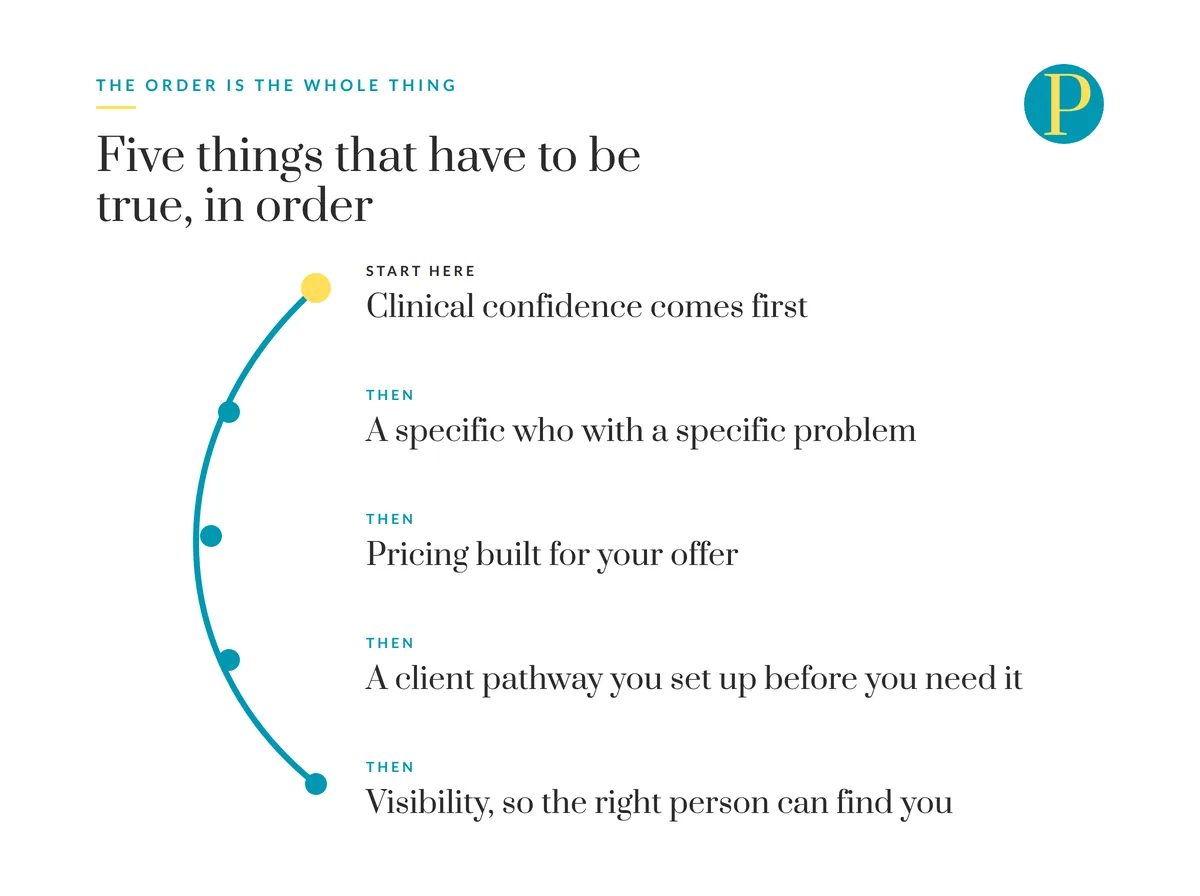
Five things. And an order, because the order is not decoration.
1. Clinical Confidence Comes First
This is a hill I will die on.
You are not going to build a life-first business on top of a skill you don’t trust. I watch it happen in coaching. Someone is weeks in, the business side is coming together, and then she starts listening to how my students talk about their cases and she goes quiet. Not because the business work is hard. Because she’s realizing she isn’t as steady clinically as she thought she was.
There’s a second version of this that worries me more. The therapist who has no clinical confidence and is going for it anyway. Full speed, no template, no protocol, figuring it out on a live client. That is not brave. That is a person and their airway on the other side of the screen.
Clinical confidence is not the same thing as having taken a course. It’s having a repeatable process you trust, one you don’t have to reinvent for every new client. My students work from a template. It’s efficient, and it has been proven thousands of times over. They don’t start from a blank page, and neither should you.
If that’s the piece you’re missing, Learn Myofunctional Therapy in 60 Days is built for it. Sixty days on purpose. Learn it, and then go build the business.
2. A Specific Who With a Specific Problem
This is where I get the most pushback, every time.
You want to be a myofunctional therapist. Not the specialist, the generalist. The general practitioner, not the endocrinologist. And the thinking underneath it is that a bigger net catches more fish.
It doesn’t.
Every visibility report I run says the same thing. Google and the AI tools sitting on top of it are asking one question about your site, which is whether you are specific for somebody. When the answer is no, you don’t rank for everyone. You rank for no one.
The reader test is simpler than the search test. Does she land on your page and feel it in her chest? Does she think, she sees me, she gets me, she knows exactly what I’m dealing with? That only happens when you picked her on purpose.
I think about it as person or passion. Are you speaking to an age or a life stage, adults, kids, men, women? Or are you speaking to a specific problem, the person whose sleep is wrecked, the one whose kid was just flagged by the orthodontist? Pick. You can go deeper on this in Why Myofunctional Therapists Aren’t Getting Clients: The Niche Mistake That Keeps You Stuck.
3. Pricing Built for Your Offer, Not Somebody Else’s Money Story
There is no mayor of myotown.
Somebody in a Facebook group tells you that you should charge two hundred a session. Somebody else tells you that in your area you can only charge one thirty-five. Both of them are strangers, and both of them are handing you something that isn’t yours.
Here’s what you’re inheriting when you take that advice. You know nothing about their business. You know nothing about their overhead, their goals, their household, or what they believe about money. You could be taking on somebody else’s lack story and calling it market research.
People need different things. Somebody who doesn’t have a business yet might be looking at what it takes to cover her bills this month. I run a business with employees, a retirement account I fund on purpose, health insurance I pay for, and a life I want to keep living. My number is not her number, and if I had let her number set my ceiling, I would not have the life I have.
Price your offer for your who, and for the number that keeps this thing alive long term. Picking a price out of a hat is the fastest way to the bottom. You have to know your nut.
4. A Client Pathway You Set Up Before You Need It
I meet a lot of therapists who say some version of, I’m broke, so I’m going to scab this together now and come back and fix it later.
You’re not saving money there. You’re building a mess you will have to pay someone to untangle.
Going into business costs money. I bootstrapped mine, which means I carried no debt, and I still spent money to start. That’s the deal.
Your client pathway is the system underneath everything. How does someone get onboarded? How do they book? How do you invoice them? How do you get paid? How does a recurring invoice run without you remembering to send it?
Set it up now, while you have the time and the calendar is quiet. You will find things that break and things that need improving, and you’ll iterate. But you’ll be iterating on something that exists instead of building it while a paying client waits.
I’ve used the same software from the beginning and I teach most of my students on it. It’s 17hats, and the reason I love it is that it’s a simple client pathway, start to finish. Plenty of people use SimplePractice or Jane instead, and that’s fine. Pick one, set it up, make the investment, and roll with it. There’s more on the underlying systems in How to Set Up Your Myofunctional Therapy Practice: The 3 Systems You Need First.
5. Visibility, So the Right Person Can Find You
Your business can’t grow if nobody knows you’re out there.
Two pieces to this now. SEO, search engine optimization, is the right words on the right page for the right person. GEO, generative engine optimization, is the same idea for the AI tools people are asking instead of Google.
Both come back to the same thing your who needs. She lands on your page and it reads like it was written for her, because it was.
I run visibility reports and website analyses on trained therapists all the time, and a lot of what I find is rough. Not because these women aren’t smart. Because nobody ever told them their website was a business asset instead of a brochure.
It’s 2026. This is a CEO skill now, not an optional one. Why You’re Not Getting Myofunctional Therapy Clients, And Exactly What to Fix walks through the visibility gaps I see most.
Why the Order Matters More Than the List
Read that list again and notice what happens if you shuffle it.
Market hard without clinical confidence and you book people you are not ready to serve. Pick a price before you pick a who and you’re guessing. Chase visibility before you have a client pathway and the people who find you fall through the floor.
The order isn’t a preference. It’s the difference between five things that compound and five things that cancel each other out.
And every one of them is business work. Not one of them is another course.
Frequently Asked Questions
Is myofunctional therapist no clients a marketing problem or a skills problem?
Almost always a business problem, and marketing is only one part of that. If you finished a reputable training and you still have an empty schedule, the gap is usually somewhere in the five above, most often the who or the visibility. More clinical training will make you better at the work. It will not put anyone on your calendar.
How many myofunctional therapy courses do I need before I can take clients?
One good one, taken all the way through, with a repeatable process you trust at the end of it. The number of courses is not what builds clinical confidence. A protocol you can follow without reinventing it every time is what builds clinical confidence. If you have that after one, you’re ready to work on the business.
What should I charge for myofunctional therapy sessions?
The number that fits your offer, your who, and what your business has to bring in to stay alive. Not the number a stranger in a Facebook group quoted you, and not the number that feels safe. Start from your own overhead and your own goals, then build the offer that gets you there.
Do I need practice management software before my first client?
You need a client pathway, and software is the cleanest way to hold one. Onboarding, scheduling, invoicing, payment, recurring billing. Set it up while the calendar is quiet, because setting it up mid-client is where the cracks show.
What is GEO and does it matter for a myofunctional therapy practice?
GEO is generative engine optimization, which is making sure the AI tools people now ask instead of searching can find you and describe you correctly. It matters for the same reason SEO does. If your site doesn’t say clearly who you serve and what problem you solve, neither Google nor an AI assistant has anything to hand the person looking for you.
Keep Listening: Related Episodes
- EP85: Why You’re Not Getting Myofunctional Therapy Clients, And Exactly What to Fix — The diagnostic version of this episode, one layer deeper on what to check first.
- EP76: Myofunctional Therapy Marketing Trained: But No Clients — What marketing looks like when the foundation underneath it is already in place.
- EP74: Why Myofunctional Therapists Aren’t Getting Clients: The Niche Mistake That Keeps You Stuck — The full version of thing number two, because the who is where most people stall.
Where to Start If You’re Trained and Stuck
If myofunctional therapist no clients is still your reality after two or three trainings, you don’t have a skills gap. You have a business that hasn’t been built yet, and that’s a fixable thing.
The first place to start is a Get Unstuck Call. We look at exactly where you are across these five, we find the one that’s holding the line, and you leave with a plan for what comes next.
And if you’re reading this and you haven’t been trained yet, start at the other end. Learn Myofunctional Therapy in 60 Days gets you clinically solid so you can move on to the part that pays you.
Go build a life you’re bonkers about.
Xo,
💙 Carmen
About Carmen Ball
Carmen Ball (formerly Carmen Woodland) is a renowned, global myofunctional therapist, business coach, and host of The Profitable Myofunctional Therapist™ podcast. Over the past decade, she has helped thousands of people in her private myofunctional therapy practice (Impact Myofunctional Therapy – formerly Integrative Myofunctional Therapy) and coached hundreds of trained therapists to build profitable online businesses of their own. She is the creator of The Profitable Myofunctional Therapist™ program and Learn Myofunctional Therapy in 60 Days or Less (LMT60), a clinical training program for dental and health professionals. Carmen’s approach is simple: you already have the skills and the license. Now let’s build the business around them. She works with therapists around the world who are ready to stop spinning their wheels and start building a business they are genuinely bonkers about.

0 Comments