

You have the tabs open. Three of them, maybe five. Every one of them is a myofunctional therapist course, and every one promises you the same thing in slightly different words. What you are trying to work out is whether any of them will get you to a paying client, or whether you are about to spend a few thousand dollars on a piece of paper and a folder of PDFs you never open again.
Here is the straight answer, and then the checklist behind it. Yes, an online course can be enough to start seeing clients. A lot of them are not, and the reason has almost nothing to do with the fact that they happen online.
Prefer to Listen Instead?
This article is based on The Profitable Myofunctional Therapist™ podcast, Episode 91: Is an Online Myofunctional Therapist Course Enough to Start Seeing Clients? You can listen to the podcast here.
Prefer to Watch Instead?
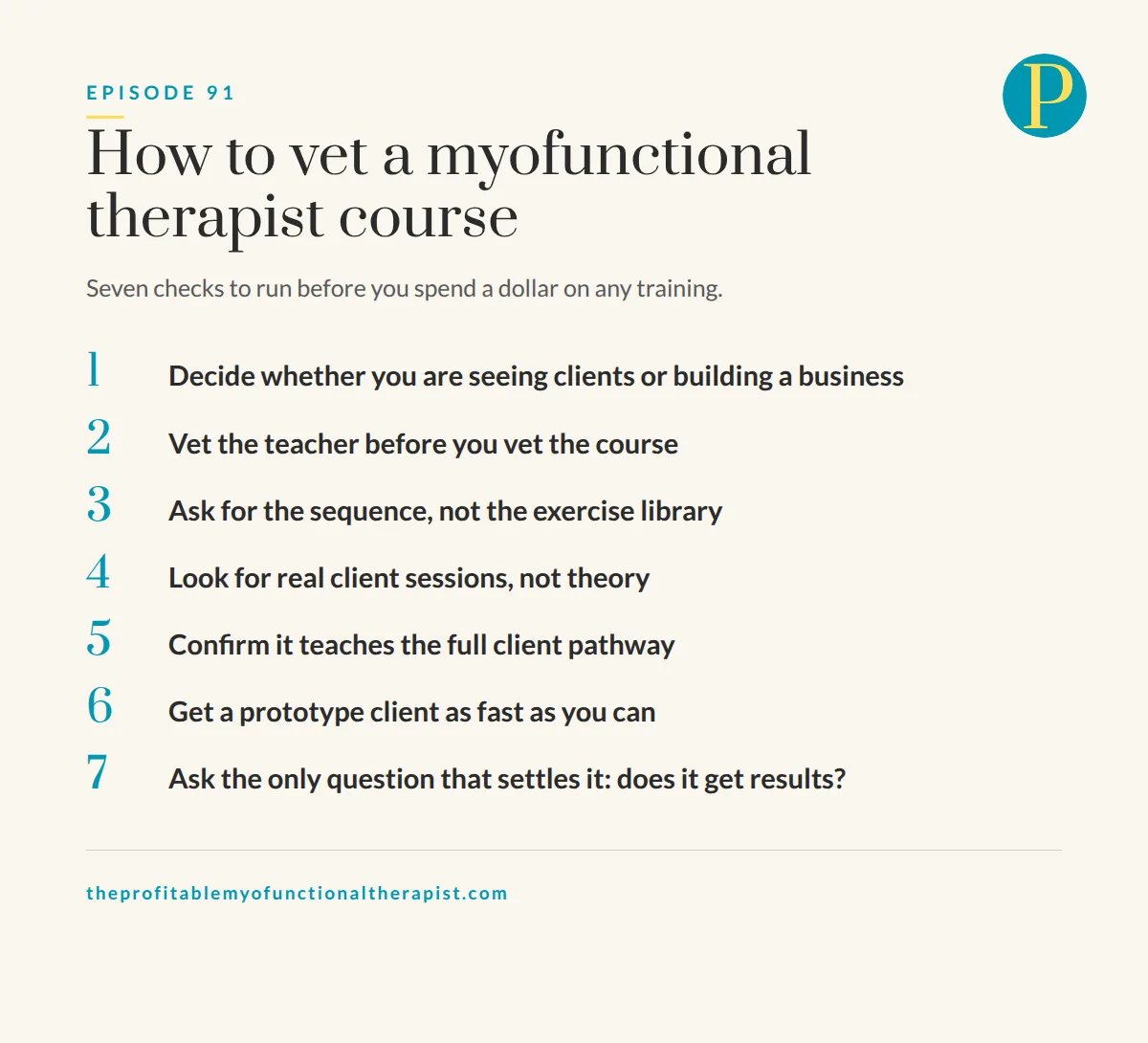
First, Decide Whether You Are Seeing Clients or Building a Business
This changes every answer below it, so settle it before you shop.
Some hygienists want to bring this work into the practice they already work in. Help the boss, help the patients, keep the paycheck. That is a real and good reason to train, and if that is you, the bar is lower. You need the clinical skill and a way to fit it into someone else’s schedule.
But if you are reading this because your wrists are done, or your body is telling you something you have been ignoring, or you want a life that does not depend on someone else’s practice staying open, then you are building a business. Look at every course through that lens. A program that teaches you exercises and stops has handed you half of what you need, and it is not the half that pays you.
Vet the Teacher Before You Vet the Course
I would think this was obvious, and then I keep meeting people who are learning from someone who has never built a practice doing this work. Years ago I had a student who was being taught myofunctional therapy by a person who had never treated a client. Not a small caseload. None.
So ask two questions about whoever is teaching.
Has this person done the thing you are trying to do? Not adjacent to it. The thing. If you want an online practice, has this person built an online practice, with a website that gets found, and clients who arrive without a referral pad?
And would you trade places with them? Because plenty of people build something that works on paper and pay for it everywhere else in their life. Success that costs someone their health or their people is not a life first business, and it is not the trade you want to sign up for.
What a Myofunctional Therapist Course Has to Teach You
This is where most training falls down, and it falls down quietly, so you do not notice until you are sitting in front of a client.
A lot of programs hand you a library. Here are the exercises. Here is what I might do if I saw this. Here is another thing I might try. That is a grab bag, and a grab bag is not a plan.
What you need is a sequence. In the way I teach it, there is an order. You teach this before you teach that, and you do a single muscle movement before you ask for a compound one. Some people move through it fast and some crawl, some find one exercise impossible and breeze through the one that stopped everybody else, and you customize as you go. But you are customizing a structure, not inventing one from scratch in the ten minutes before the appointment.
I have an exercise library too. Hundreds of options. Handing that to a brand new therapist with no skeleton underneath it is not generosity, it is overwhelm with a nice cover on it.
That distinction is the whole ballgame. Ask any program you are considering to show you the sequence, not the library.
Look for Real Client Sessions, Not Theory
Ask whether you get to watch real client work. Not a demo with a colleague. Real appointments, start to finish.
Watching someone run an exam teaches you things a written protocol cannot. How the conversation opens. What gets asked and in what order. What it looks like to be relaxed while gathering everything you need. Where the client pushes back and how that gets handled without the whole session going sideways.
If a course cannot show you a client pathway on video from the first appointment through the last one, ask why.
Confirm the Course Teaches the Full Client Pathway
Your client pathway is everything it takes to move a human from interested to graduated.
The first conversation. The exam. Onboarding. How the offer gets presented. How you get paid, and how recurring invoices get set up so you are not chasing anybody. The check-ins. The finish.
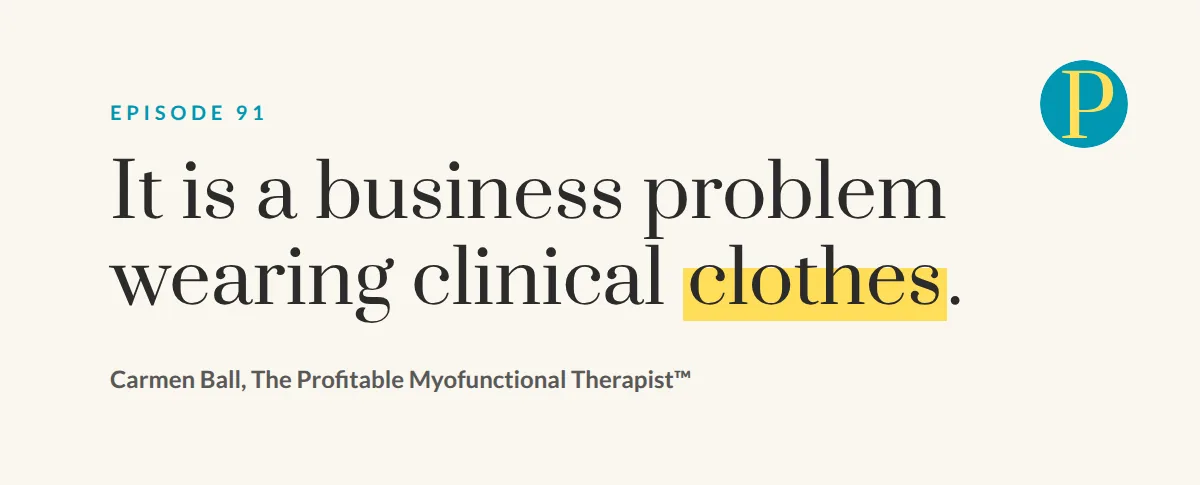
Most clinical training stops at the therapy and leaves the rest for you to invent on the fly. That is where the frustration comes from, and it is almost never a clinical problem. It is a business problem wearing clinical clothes.
Set that pathway up once, set it up right, and it stops taking energy from you. That is also the difference between a practice that needs you touching everything and one that runs on a system. I have coaching clients right now with clinical training from elsewhere and no pathway underneath it, and what they are dealing with is not a knowledge gap. It is a clunky, manual setup that depends entirely on them being available.
Get a Prototype Client as Fast as You Can
Here is the part nobody wants to hear.
Your first real client is where you find out what is broken. Not your notes. Not your third pass through the modules. The client.
You will learn in one exam what six more weeks of studying would not have shown you. This is inefficient. This step takes too long. This form asks for the wrong thing. That feedback only exists on the other side of doing it.
So while you are sitting there wondering whether a course is enough to start seeing clients, understand what the question is asking. A course is enough if it teaches you what you need to know and leaves you able to go get a client. Then you implement, you find the rough edges, and you fix them.
My whole template came out of exactly that. I finished a twelve week training and got to the end thinking, fine, but now what? So I sat in a park in Chicago with a legal pad and built the thing I wished the course had given me. Repeatable. Efficient. Best use of the session time. I have taught it that way for years.
Then Ask the Only Question That Settles It
Does the approach get results?
Not whether it checks a clinical box. Not how many hours it took or what the completion document looks like on your wall. Does the way this program teaches you to work produce change in the people you treat, and does it leave you able to run a business at the same time.
That is the whole test. Everything else is packaging.
Frequently Asked Questions
Is an online myofunctional therapist course enough to start seeing clients?
It can be. The format is not the problem. What matters is whether the training gives you a sequence rather than a pile of exercises, lets you watch real client sessions, covers the full client pathway including how you get paid, and leaves you ready to go find your first client instead of ready to enroll in something else.
Do I need to be a dental hygienist to become a myofunctional therapist?
No, though hygienists tend to move fast in this work because so much of the foundation is already there. You have looked in thousands of mouths, you can talk to a nervous person, and you already understand the tissue you are looking at. That is a head start, not a requirement.
How long does myofunctional therapy training take?
It varies widely. Some programs run a weekend, some run twelve weeks, some stretch across a year. Length by itself tells you very little. A short program with a clear sequence and real client footage will leave you more prepared than a long one that hands you theory. Look at what is covered, not how many weeks it fills.
What should a myofunctional therapy course include?
At minimum, a teaching sequence you can follow with an adult and with a child, recorded client sessions from exam through completion, the business side of the client pathway, and a way to reach the instructor with questions once you are working with clients.
Can I train while I am still working in the op?
Yes, and most people do. That is the whole reason to keep the paycheck while you build. Here is what that transition looks like, including the part where the two overlap for a while.
I already took a course and I still feel unprepared. Do I need another one?
Usually not. If you know how to do the therapy and you have no clients, another clinical program will not fix that. What is missing is the business underneath it. Take an honest look at whether your gap is clinical or structural before you spend again.
Keep Listening: Related Episodes
- EP77: The Best Myofunctional Therapy Courses for Dental Hygienists in 2026 — The natural next step once you know what to look for, this one lines up the real options side by side.
- EP79: Why Dental Hygienists Are the Perfect Candidates for Myofunctional Therapy Training — If you are wondering whether your background is enough to do this work, start here.
- EP83: From Hygienist to Myofunctional Therapist: What the Transition Really Looks Like — The honest version of the timeline, including what happens to your paycheck along the way.
Where to Start If You Have Not Trained Yet
If you are still in the op and you have been circling this for a year, the thing that changes your situation is not more research. It is picking a myofunctional therapist course that teaches you the clinical work and the client pathway together, then getting in front of your first client before the material goes cold. That is why Learn Myofunctional Therapy in 60 Days is built the way it is. The sixty days describes the length of the training, not how fast your calendar fills, and the deadline exists to keep you from living in the learning phase for two years. Use code T2BCHECKLIST to save $100.
You do not need to feel ready. You need a sequence, a pathway, and a first client. The readiness shows up after.
Xo,
💙 Carmen
About Carmen Ball
Carmen Ball (formerly Carmen Woodland) is a renowned, global myofunctional therapist, business coach, and host of The Profitable Myofunctional Therapist™ podcast. Over the past decade, she has helped thousands of people in her private myofunctional therapy practice (Impact Myofunctional Therapy – formerly Integrative Myofunctional Therapy) and coached hundreds of trained therapists to build profitable online businesses of their own. She is the creator of The Profitable Myofunctional Therapist™ program and Learn Myofunctional Therapy in 60 Days or Less (LMT60), a clinical training program for dental and health professionals. Carmen’s approach is simple: you already have the skills and the license. Now let’s build the business around them. She works with therapists around the world who are ready to stop spinning their wheels and start building a business they are genuinely bonkers about.
0 Comments