
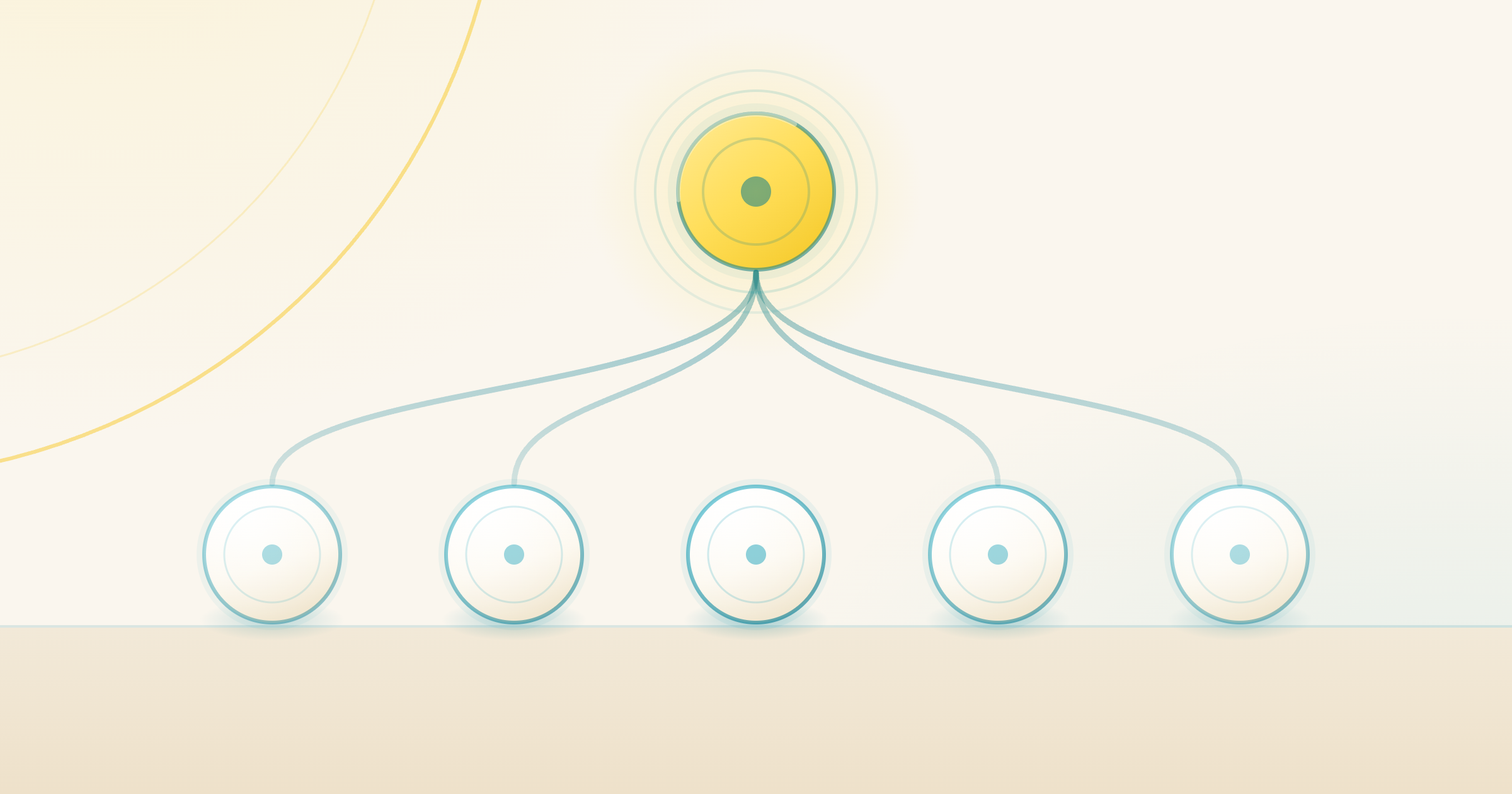
My oldest daughter took one look at what I had been building, started laughing, and told me that Claude is a robot mom and I am putting together some kind of convent of people. I told her no, honey. That is an org chart. AI for myofunctional therapists sounds like a tech conversation, and it is not. It is a staffing conversation, and it starts in the season where you cannot afford to hire anybody yet.
Three questions keep landing in my Facebook community, in my podcast comments, and on my coaching calls. What is an AI employee. Where do you get one. What does it do for you all day. Here are all three answers in plain language.
Prefer to Listen Instead?
This article is based on The Profitable Myofunctional Therapist™ podcast, Episode 93: My Top Five AI Employees and What They Do. You can listen to the podcast here.
Prefer to Watch Instead?
What an AI Employee Is, in Plain Language
An AI employee is not a chatbot you type a question into and hope for something usable. That is a search bar with better manners.
An AI employee starts with something you already do repeatedly. You take that thing and you write it down as a standard operating procedure, step by step, the same way you would if you were handing it to a person you just hired. Then you train it. You correct it. You tell it this is right and this is wrong, over and over, and a lot of it breaks before any of it works.
What makes it an employee rather than a tool is what happens on the other side. It hands you finished work. It asks you for input when it needs something only you have. It tells you when something does not add up. It talks back, in the useful way.
You Cannot Train or Automate Chaos
Here is the part nobody wants to hear. If you do not have a process, you do not have anything to hand it.
A lot of therapists come to this with chaos, and chaos cannot be trained. You cannot hire a person into it either. The process has to exist first, and writing that process down is the real work. The AI part is the easy part.
That is also the honest reason so many people try this, get generic output, and decide it does not work for their business. They fed it a generic idea. It knew nothing about their voice, their offer, their ideal client, their pricing, or how they make money. Of course it handed back something that could belong to anyone.
The Five AI Employees I Run Every Week
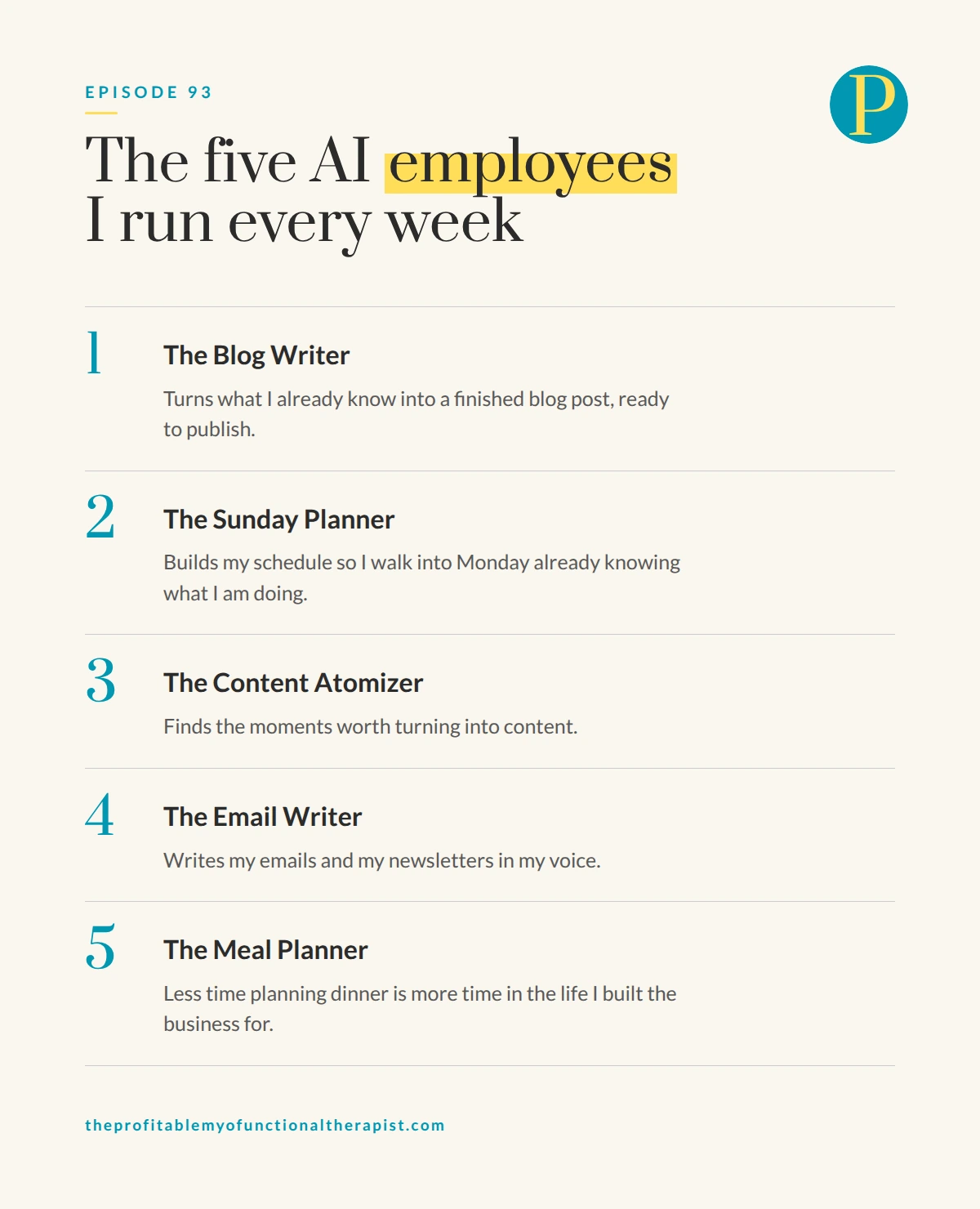
These five are mine. What they hand back to me is what I get out of them, and your mileage depends entirely on the process you build and how well you train it.
1. The Blog Writer
I hand it what I already know, and it turns that into a finished blog post that is ready to publish and built to show up in search.
Mine knows my voice. It knows my founder story. It knows my brand, my colors, my rules, and the specific words I refuse to let anyone put in my mouth. Everything it writes runs through my anti-AI writing guidelines before it ever gets to me. That is the difference between a blog writer and a prompt.
I run two versions, one for standalone posts and one that lives inside the podcast workflow.
2. The Sunday Planner
Every Sunday morning I sit down with my coffee and say four words. Run the Sunday planner.
It reads my task list in ClickUp, looks at my week, and builds my schedule so I walk into Monday already knowing what I am doing. Then it keeps going. It asks me what is a priority this week, whether anything is missing from the list, and it makes me brain dump whatever is rattling around in my head. It looks one, two, three, four weeks out and asks what is coming that I should be handling now because I will be out of the office when it lands.
It reads my calendar for conflicts. When something shows up in green, which is the Ball family calendar, it asks me whether pest control on Wednesday at two is mine or Scott’s.
And the last thing it does every Sunday is pull my metrics. What Instagram did. What the website traffic looks like. So I start the week knowing what is working before I build a single piece of content.
3. The Content Atomizer
This one takes a podcast episode, a sales call recording, or anything else I have already said out loud, and finds the moments worth turning into content.
I do not sit down to a blank page. Between this and the scout that goes out every night to tell me what stuck myofunctional therapists are saying online, my problem flipped from what do I post to which of these do I use first. That is a much better problem.
4. The Email Writer
She writes my emails and my newsletters in my voice, so I am not starting from nothing every time I sit down. She hands me drafts. I finalize them and make them mine.
When I am blocked, she asks me questions instead of guessing. What is going on in your personal life. What is a win you have had recently. What has been hard. That is why the personal part of my Sunday letter is personal.
The piece I love most is the parking lot. If I am on a hike or floating in the pool and an idea shows up, I say put this in the parking lot and then I ramble. World’s biggest run-on sentence, no coherent thought required. It files it in ClickUp and in Notion, and weeks later when I sit down to write, it says idea number sixteen matches this week’s topic, do you want to run with it.
5. The Meal Planner
This one has nothing to do with business and it might be my favorite.
It starts with a voice memo. I walk through the house saying here is what is in the fridge, here is what will go bad, here is the meat in the freezer, here is half a brick of cream cheese and some tortellini and a jalapeno. Then it interviews me about the week. Clients until late Wednesday means Scott handles dinner, so Wednesday needs to be something he can put together without a recipe.
It knows we do Mexican on Tuesday, so it rotates. Ground beef tacos last Tuesday, shredded beef this Tuesday, carnitas next. It asks about leftovers, tells me what is on sale where, and builds a grocery list I can tap through at the store.
Less time planning dinner is more time in the life I built the business for. That is the whole point.
Why This Matters in the Season You Are In
Every one of you will have a stretch where you cannot afford to hire help. That is not a failure. That is a season.
And in a niche this small, hiring is hard even when the money is there. Myofunctional therapy is tiny and it requires real understanding. When I brought people in to write blogs and emails for me, I spent more time correcting their work than I would have spent doing it myself.
So I did what everybody does. I told myself I would just do it myself, because that saves time.
It does not. That mentality feels efficient in the moment and it hurts you in the long run, because every hour you spend working in the business is an hour you did not spend working on it.
Frequently Asked Questions
What is an AI employee in a myofunctional therapy business?
It is a trained assistant built around one of your existing processes. You document how you do something, train the AI on your voice, your offers, and your standards, correct it until the output is right, and then it produces that work on request and asks you for input when it needs it.
Do I need to be technical to use AI for myofunctional therapists?
No. You need a process. The writing-it-down part is where the real work lives. If you can explain how you do something clearly enough to hand it to a new hire, you can train an AI employee to do it.
Which AI employee should I build first?
Build the one for the task you do most often and dread most. For most therapists that is content or scheduling, because those are the two things that quietly eat the week. Start with one. Get it right before you build a second.
Why does AI give me generic content?
Because you gave it a generic input. If it does not know your voice, your ideal client, your offers, your pricing, and the words you refuse to use, it has nothing to work with except the internet’s average. Training is what removes the generic.
Can AI replace hiring a real person?
No, and that is not what it is for. It fills the gap in the season before you can hire, and it takes the repeatable work off your plate so the person you eventually hire is doing something that needs a human.
Keep Listening: Related Episodes
- EP92: The CEO Systems Your Myofunctional Therapy Practice Needs Before You Think You Are Ready: The systems this episode automates, laid out before you automate anything.
- EP65: How to Set Up Your Myofunctional Therapy Practice: The 3 Systems You Need First: Start here if you do not yet have a process to hand anyone.
- EP68: How to Organize a Myofunctional Therapy Business: What to Set Up First: Organizing comes before automating, every single time.
Start With One Process, Not Eighty
You do not need eighty AI employees. You need one, built around one process you already run, and the willingness to correct it until it is right.
If you are trained, you are earning some money, and you are buried under the organizing and the setup and the where-did-my-week-go of it all, AI for myofunctional therapists is the conversation I want to have with you. Book your Get Unstuck Call and we will look at what you are doing every week, find the process worth handing off first, and figure out your next step from there.
Xo,
💙 Carmen
About Carmen Ball
Carmen Ball (formerly Carmen Woodland) is a renowned, global myofunctional therapist, business coach, and host of The Profitable Myofunctional Therapist™ podcast. Over the past decade, she has helped thousands of people in her private myofunctional therapy practice (Impact Myofunctional Therapy – formerly Integrative Myofunctional Therapy) and coached hundreds of trained therapists to build profitable online businesses of their own. She is the creator of The Profitable Myofunctional Therapist™ program and Learn Myofunctional Therapy in 60 Days or Less (LMT60), a clinical training program for dental and health professionals. Carmen’s approach is simple: you already have the skills and the license. Now let’s build the business around them. She works with therapists around the world who are ready to stop spinning their wheels and start building a business they are genuinely bonkers about.

0 Comments