
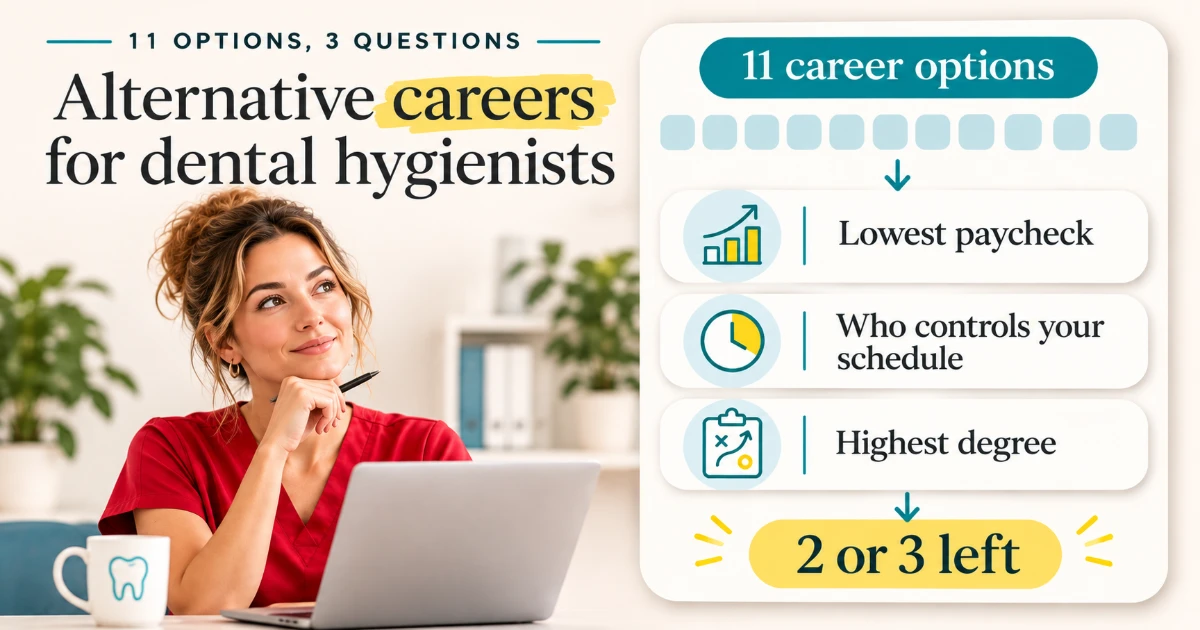
Alternative careers for dental hygienists fall into a few lanes: public health, education, product training, sales, writing and speaking, office management, and clinical work outside the standard operatory. Some ask for a bachelor’s degree or a starting pay cut, so choose by what you can’t give up, like pay floor, schedule, and degree level.
I was sitting across a restaurant table from my boss at my two-year evaluation. A year earlier she had called me the rock star of the office. This time she called me the cancer of the office, and the only thing that had changed was that I’d grown a spine and started standing up to her. She’d just been handed a six percent cost-of-living raise, and our hygiene production goals went up to pay for it while my paycheck stayed exactly where it was. My chest went tight, and what I felt was clarity. I wanted out of hygiene like yesterday.
I never looked at the other ten options below. I did my research on myofunctional therapy, saw how much of my hygiene skill carried over, and what pulled me in was that I could do it online, because I knew, 150 percent, that I wanted an online business and never a brick-and-mortar. So I can’t tell you what the other ten feel like from the inside. I teach this one, though. It’s how I left hygiene in August 2018 after sixteen years, and I train hygienists in it through Learn Myofunctional Therapy in 60 Days (or Less), which I call LMT60. It sits at number eleven so you weigh the other ten first.
What I can give you is what each source says, with the catch on each. I linked every one so you can check me, and none of them publish pay figures, so I won’t guess at your market.
Alternative Careers for Dental Hygienists: The List
1. Public health
ADEA lists local and state dental public health officer, community clinic administrator, and National Health Service Corps roles. RDH Magazine adds in-school sealant programs and VA clinics, and warns that leaving clinical practice may take more than an associate degree.
2. Education
ADEA lists instruction roles, program director, and dean. Today’s RDH says clinical instructor roles are open without an advanced degree, while RDH Magazine says most dental hygiene programs want a bachelor’s or master’s to teach. The title decides which rule applies.
3. Product educator for a dental company
Dental companies hire hygienists to lead lunch-and-learns and host webinars, which Today’s RDH calls highly sought after and not necessarily sales. You’d be on the company’s calendar, so ask what a normal month looks like.
4. Dental sales
ADEA lists pharmaceutical and dental-supply sales. RDH Magazine says most sales positions require at least a bachelor’s and many pay a base plus commission. If the word commission made your stomach drop, cross this one off.
5. Writing and speaking
RDH Magazine says no specific degree is required to speak. Today’s RDH describes the key opinion leader route, where a respected name in a niche endorses companies at lectures and seminars and on social media. Nothing in the source promises a salary here, so I’d build it alongside another income.
6. Dental office management and consulting
ADEA lists dental office manager and hospital or nursing home consultant. You already know where an office loses money and patience, because you’ve watched it from the chair.
7. Dental insurance
ADEA lists dental insurance officer among its career options. A desk job should ease the strain on your wrists, so ask someone who does it what a Tuesday looks like.
8. Safety and compliance training
Today’s RDH describes the OSHA outreach trainer, who is self-employed, completes coursework to be authorized by the Department of Labor, and can teach radiation safety and HIPAA compliance. You’d be selling your own training days, so you’re running a small business.
9. Brand ambassador
Today’s RDH says brand ambassadors usually work as independent contractors, often earn commission on product sales, and typically treat it as supplemental income. Treat it as a side lane.
10. Clinical work outside the standard office
RDH Magazine lists mobile care for older adults, dental therapist and midlevel roles, and practice ownership in certain states. NCSL‘s state table shows the rules differ, so look up yours before you fall in love with this one.
11. Myofunctional therapy
This is the one I know from the inside. A December 2025 study in the Journal of Dental Hygiene looked at hygienists working as myofunctional therapists and named cost and complexity as the biggest barriers, with autonomy and a wide array of work as the advantages.
Here’s the catch. More clinical training costs money, nobody hands you clients when you finish, and you end up running a business whether you meant to or not. What I wish I’d known in year fourteen or fifteen is how much easier the move was than I’d made it in my head, and how much better my body, my mind, and my spirit felt on the other side. I wrote about the skills that carry over from hygiene if you want to see where you’d start ahead.
What most of these ask of you before they hire you
Elisa Brittain, writing in Today’s RDH, says it’s not uncommon for nonclinical positions to require at least a bachelor’s degree, and you may need a bit of a pay decrease to get your foot in the door. Her first step out was helping at a dental conference booth on a weekend while she still worked as a hygienist. It paid poorly, meant an hour on the train each way, and started her contacts.
Her advice is the part I’d tape to the wall: take as many opportunities as you can outside clinical hygiene, and reach out to people you know who already made the jump. If you’re waiting for the right job to appear and rescue you, it won’t.
I did mine in the gaps. I’d given myself five years to get out of hygiene. I registered for myofunctional therapy training in October 2016, started it in January 2017, and booked my first paying client in May 2017, all while working three very long days a week with a three-hour round-trip commute on each, and building on my days off. By July I’d cut back to part-time at a job in my own town, and thirteen months after that I walked out of hygiene for good.
How to choose when every option looks possible
A hygienist told me this fall that her body was already feeling it, and that what she wanted was flexibility and more money, with a day or two of hygiene left in the week for the patients she likes. That’s a set of requirements, and it’s a better starting point than a job title.
Settle three before you read another posting: the lowest paycheck you can live on, who controls your schedule and where you work, and the highest degree you’re willing to pursue.
Pay floor comes first, because it’s where I got it wrong. I was burning the candle at both ends, building on my days off and still trying to earn my exact hygiene number every month. I could have gotten by on $1,000 less a month, and that would have bought me another day out of hygiene to build. It took me about six months to see I was running a lack mentality. I hadn’t learned the concept of enough yet, and a bare-bones paycheck buys you time on the calendar.
Control comes next, and hygienists tend to find out late who has it. I learned who controlled my income across a restaurant table after sixteen years.
You’re not going to leave and drive to New York City without a plan. Run each option you keep through those three, and two or three will survive, which is plenty. Then spend this month talking to people who hold those jobs.
If you’d rather keep working while you build something on the side, my post on career change for hygienists covers that version.
If myofunctional therapy is still on your list
LMT60 is self-paced online clinical training with six modules and more than 30 lessons. The LMT60 page has the details.
Friend, a list of alternative careers for dental hygienists changes nothing until you pick one job on it and message someone who already does it. You can do that before dinner.
Xo,
💙 Carmen
Frequently Asked Questions
What non-clinical jobs can a dental hygienist do?
ADEA’s list includes public health, education, consulting, sales, insurance, and office management, and Today’s RDH adds product educator, OSHA outreach trainer, and brand ambassador. Elisa Brittain says it’s not uncommon for nonclinical positions to require at least a bachelor’s degree, so check each posting before you plan around it.
Can a dental hygienist work from home?
True work-from-home hygiene roles are extremely rare. I broke down what each remote option involves in my post on dental hygienist remote work.
Do alternative careers for dental hygienists pay less?
Some may at the start. Today’s RDH says you may need to take a bit of a pay decrease to get your foot in the door, and the sources I read don’t publish pay figures, so check postings in your market. Ask people already in the job what their first year paid.
Do you need a bachelor’s degree to leave clinical hygiene?
Often, yes. Today’s RDH says it’s not uncommon for nonclinical positions to require at least a bachelor’s, and RDH Magazine says most sales positions do and most dental hygiene programs want a bachelor’s or master’s to teach. Clinical instructor roles can be open without an advanced degree, and RDH Magazine says no specific degree is required to speak.
Is myofunctional therapy a good alternative career for dental hygienists?
It can be, and it comes with a catch: more clinical training costs money, and you build your own client base. The Career Fit Guide for Dental Hygienists walks you through the fit questions, and my post on going from dental hygienist to myofunctional therapist shows the path. The LMT60 page has the training details.
About Carmen Ball
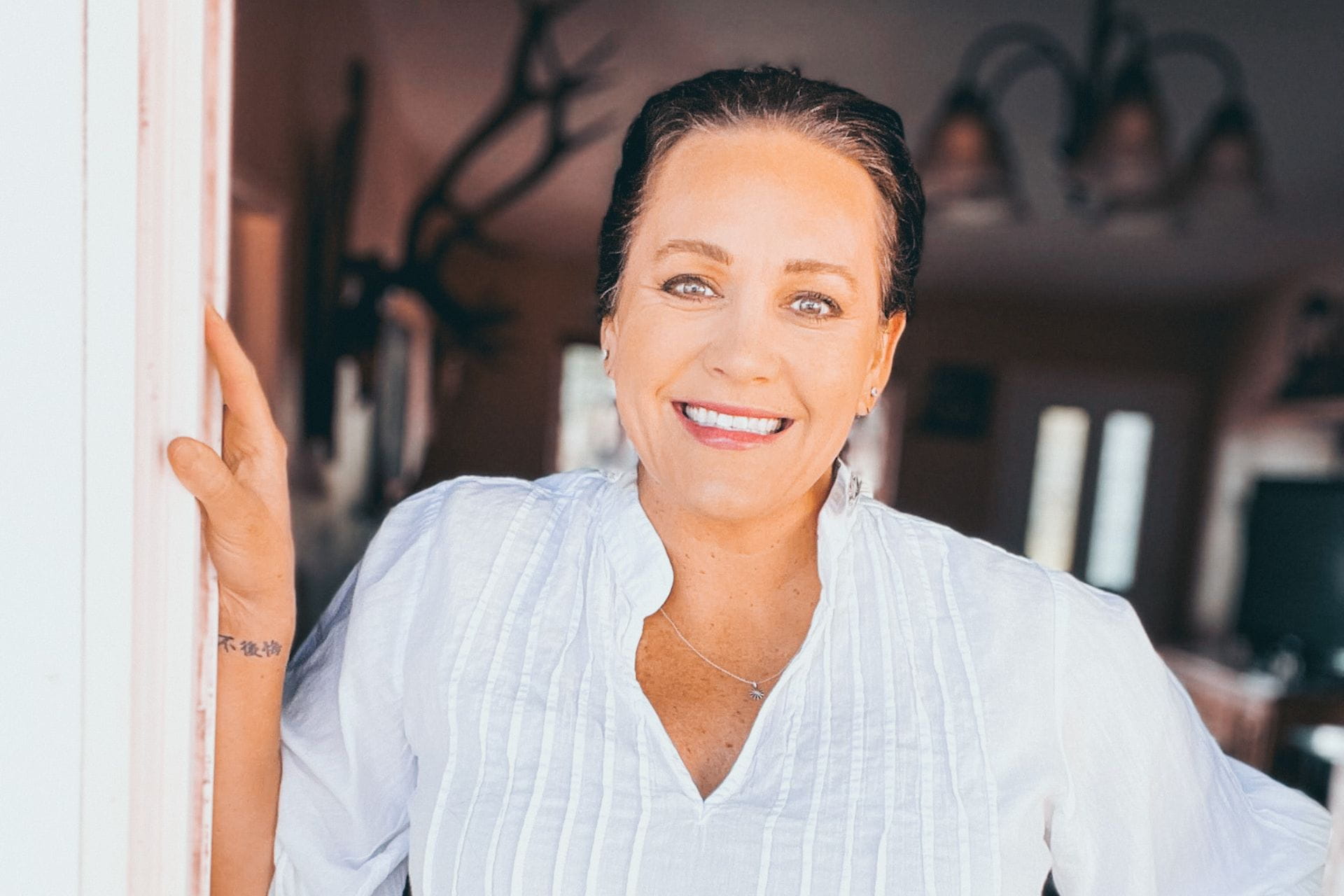
Carmen Ball (formerly Carmen Woodland) is a renowned, global myofunctional therapist, business coach, and host of The Profitable Myofunctional Therapist™ podcast. Over the past decade, she has helped thousands of people in her private myofunctional therapy practice (Impact Myofunctional Therapy – formerly Integrative Myofunctional Therapy) and coached hundreds of trained therapists to build profitable online businesses of their own. She is the creator of The Profitable Myofunctional Therapist™ program and Learn Myofunctional Therapy in 60 Days or Less (LMT60), a clinical training program for dental and health professionals. Carmen’s approach is simple: you already have the skills and the license. Now let’s build the business around them. She works with therapists around the world who are ready to stop spinning their wheels and start building a business they are genuinely bonkers about.
0 Comments